NFPA 96 Certified Hood Cleaning

Raleigh Fire Marshal and Wake County Compliance, Documented

Inside the city, your authority is the Office of the Fire Marshal at the Raleigh Fire Department, based in the Dillon Building at 310 W. Martin Street. Outside the city limits — plus Rolesville and Wendell — it is the Wake County Fire Marshal’s Office, which enforces the North Carolina Fire Code across unincorporated Wake County.

Raleigh publishes its inspection cycle, and restaurants sit at the top of it: restaurants, clubs and places of entertainment are inspected annually. Industrial and educational occupancies are inspected every two years, mercantile and storage every three. If you operate a restaurant in Raleigh, you are on the shortest fire-inspection cycle the city runs.

You also answer to a second inspector. Wake County Environmental Health & Safety states that restaurants are inspected one to four times a year, depending on menu items and food processes — so a scratch kitchen handling raw proteins sees an inspector far more often than a cafe reheating prepared food.

Two authorities, two records. The fire marshal is looking at your exhaust system and suppression; the health inspector is looking at the kitchen around it. NFPA 96 requires a certificate kept on the premises naming the servicing company, the person who performed the work and the date — Kitchen Guard leaves that certificate after every visit, with before-and-after photographs attached.

Learn More About Us
Commercial kitchen equipment repairs by Kitchen Guard technician
What Sets Us Apart

Why Raleigh Kitchens Call Kitchen Guard

From the hood filters to the rooftop fan, we clean the whole system and document it for both of the inspectors who walk through your door.

Kitchen Guard is a Piedmont Triad company that runs Raleigh on a scheduled route, and we would rather say that plainly than imply a storefront off Glenwood Avenue. What the model gives you is predictability: a booked slot after close, a crew carrying the access panels and hinge kit the job needs, and a documented result waiting in the morning.

We clean the complete system — canopy, filters, plenum, the full duct run and the rooftop fan — and photograph it before and after. One record satisfies the fire marshal; the clean kitchen underneath it is what the health inspector sees on a visit that may come four times a year.
What Sets Us Apart

Why Raleigh Kitchens Call Kitchen Guard

From the hood filters to the rooftop fan, we clean the whole system and document it for both of the inspectors who walk through your door.

  • NFPA 96 compliance — Kitchen Guard
    We Know the Code
    Our technicians work to NFPA 96 as it is enforced here — by the Office of the Fire Marshal at the Raleigh Fire Department inside the city, and the Wake County Fire Marshal’s Office beyond it. That includes the six-month servicing of the hood and its suppression system that North Carolina fire marshals cite most often.
    We Know the Code

    Our technicians work to NFPA 96 as it is enforced here — by the Office of the Fire Marshal at the Raleigh Fire Department inside the city, and the Wake County Fire Marshal’s Office beyond it. That includes the six-month servicing of the hood and its suppression system that North Carolina fire marshals cite most often.

  • Inspection Reports with Digital Photos
    Every visit produces before-and-after photographs of the canopy, plenum, duct run and rooftop fan, plus a dated certificate naming the servicing company, the technician and the date — the record NFPA 96 requires you to keep on the premises.
    Inspection Reports with Digital Photos

    Every visit produces before-and-after photographs of the canopy, plenum, duct run and rooftop fan, plus a dated certificate naming the servicing company, the technician and the date — the record NFPA 96 requires you to keep on the premises.

  • A Scheduled Triangle Route
    We are based in the Piedmont Triad and serve Raleigh on a scheduled route — 77 miles down I-40, about an hour and twenty minutes. Routed work is what makes overnight service practical, and it is how a Raleigh job gets priced and documented the same way a Raleigh one does.
    A Scheduled Triangle Route

    We are based in the Piedmont Triad and serve Raleigh on a scheduled route — 77 miles down I-40, about an hour and twenty minutes. Routed work is what makes overnight service practical, and it is how a Raleigh job gets priced and documented the same way a Raleigh one does.

  • 24/7 Support
    We are available around the clock for questions about NFPA 96 compliance, scheduling, or an exhaust problem that cannot wait until morning.
    24/7 Support

    We are available around the clock for questions about NFPA 96 compliance, scheduling, or an exhaust problem that cannot wait until morning.

  • Professional & Reliable Technicians
    Additionally, our experienced team specializes in commercial kitchen cleaning and ensures your exhaust hood and air vent cleaning are handled with precision.
    Professional & Reliable Technicians

    Additionally, our experienced team specializes in commercial kitchen cleaning and ensures your exhaust hood and air vent cleaning are handled with precision.

  • Emergency SMS Alerts
    Consequently, you stay informed with instant alerts about hood NFPA compliance, scheduled services, or emergency maintenance needs.
    Emergency SMS Alerts

    Consequently, you stay informed with instant alerts about hood NFPA compliance, scheduled services, or emergency maintenance needs.

Commercial hood cleaning service in progress
NFPA 96 CERTIFIED HOOD CLEANING

Raleigh Hood Cleaning Service Details

Hood Cleaning
RALEIGH’S HOOD CLEANING SPECIALISTS

What a Full-System Clean Includes

Serving Raleigh, Wake County and the I-40 corridor

Every Kitchen Guard service covers the complete exhaust path:

  • Hood canopy, interior and exterior surfaces
  • Grease removal filters — cleaned, inspected for damage, and reseated with proper overlap
  • Plenum chamber behind the filters
  • The full horizontal and vertical duct run, through every access panel
  • Rooftop exhaust fan — lifted on its hinge kit, degreased, with belt and bearing condition checked
  • Grease containment at the fan, and roof surfaces protected during the work

“Cleaned to bare metal” is the phrase the trade uses. What the standard actually requires is that surfaces be cleaned to remove combustible contaminants to a minimum of 0.002 in. — fifty microns. That is the number behind the phrase, and it is measurable.

You get before-and-after photographs and a dated compliance certificate. If there is something we could not reach — a duct run with no access panel, a section that needs a panel cut in — it goes in the report rather than quietly being left out of it.

Every Kitchen Guard service covers the complete exhaust path, not only the parts that are easy to reach.

aKitchen Guard technician pressure-washing a commercial kitchen exhaust hood behind containment sheeting
Every Kitchen, Every Compliance Standard

Commercial Kitchen Exhaust Cleaning for Every Type of Raleigh Kitchen

Raleigh’s kitchens keep very different hours — a late-night bar on Glenwood, a convention hotel banquet line, a hospital production kitchen that never closes, an arena concession stand that cooks twelve nights a month. The right interval follows the cooking, not the square footage.

we cover it all.

Restaurant

Restaurants

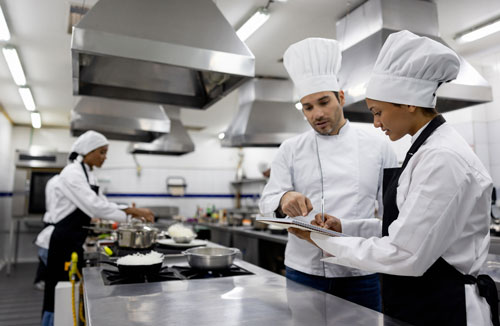
Glenwood South and the Warehouse District cook hard and close late, which leaves a narrow overnight window. We book it in advance, clean the full system, and leave the certificate and photographs before the morning prep shift arrives.

Corporate-Cafeteria

Corporate Cafeterias

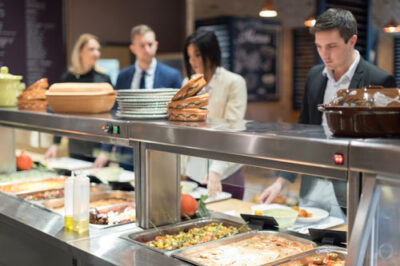
NC State’s dining operations and the corporate campuses out toward Research Triangle Park run contract-managed kitchens. Those accounts need scheduled service, standardized reporting, and intervals that hold across every site under one agreement.

Sports-Venues

Sports & Event Venues

Concession kitchens at the Lenovo Center, the NC State Fairgrounds and the Atlantic Union Bank Convention Center cook in short, heavy bursts on a calendar published a season ahead. We work the gaps between events so every stand is ready for the next gate.

Hospital-Kitchen

Hospitals & Assisted Living

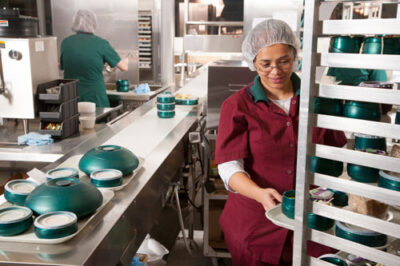
WakeMed, UNC Rex and Duke Raleigh run production kitchens that cannot close. Phased overnight work keeps service running, and the documentation requirements in healthcare are the strictest of any category we handle.

School campus commercial kitchen — Kitchen Guard cleaning services

Educational
Institutions

Raleigh inspects educational occupancies every two years, and campus kitchens at NC State and across Wake County Public Schools run to an academic calendar — which makes the service windows predictable and worth booking well ahead of term.

Hotel-Kitchen

Hotel Chains

Convention hotels downtown, the North Hills cluster and the Brier Creek corridor near RDU swing from idle to full banquet output for a single event. Grease load tracks events rather than covers, and the inspection standard is the same as any restaurant.

The Visionary Behind Kitchen Guard

Meet The Founder

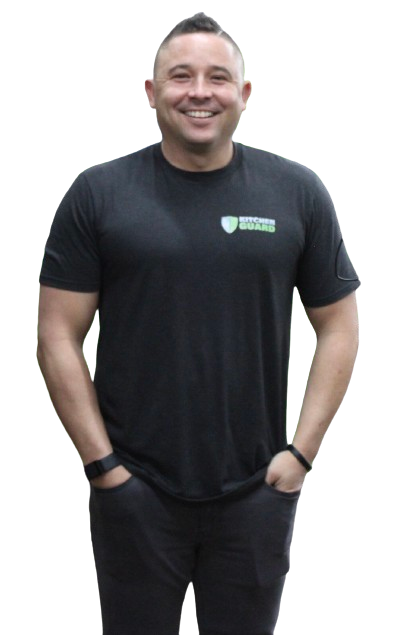
Nathan Leathers founded Kitchen Guard of the Piedmont Triad to make certified, professional hood cleaning accessible to every restaurant and commercial kitchen in North Carolina — from single-location independents to hospitals, schools and multi-site restaurant groups.

Nathan Leathers, founder of Kitchen Guard

Explore More Kitchen Guard Services:

Hood Cleaning Services → All Services → Filter Exchange → Get a Quote →

GREENSBORO HOOD CLEANING FAQ

Frequently Asked Questions

Below are common questions from Raleigh restaurant owners and food service operators about NFPA 96 hood cleaning compliance.

Our NFPA 96 certified team brings extensive expertise to every job. Additionally, we use commercial-grade cleaning solutions approved for kitchen exhaust systems. Furthermore, our technicians document every service with before-and-after photos. As a result, you have proof of compliance ready for any inspection. In addition, we schedule cleanings around your business hours to minimize disruption. Moreover, our service reports are formatted to meet insurance and fire marshal requirements. Consequently, our clients consistently pass fire department inspections on the first review.

Who enforces the fire code for a Raleigh restaurant?

The Raleigh Fire Department’s Office of the Fire Marshal, in the Dillon Building at 310 W. Martin Street, Suite 200 — 919-996-6392, or fireprevention@raleighnc.gov. The office inspects new and existing commercial buildings for fire and life safety compliance and reviews plans before construction. Wake County’s fire marshal is not your authority: that office covers unincorporated Wake plus Rolesville and Wendell only.

Then who handles our sanitation inspection?

Wake County Environmental Health and Safety, on 919-856-5700, through its Food, Lodging, Institution and Specialties programme. The split is worth understanding because it is the reverse of what people assume: in North Carolina, fire code enforcement is municipal while restaurant sanitation is a county health function. So your exhaust system answers to the city and your kitchen hygiene answers to the county, and neither office will tell you much about the other’s requirements.

We trade at the State Fair. Does a temporary kitchen need any of this?

Yes — a hood is a hood whether or not it has wheels. The State Fair drew 946,811 people across eleven days in 2025 and returns 15 to 25 October in 2026, and the concessions feeding that crowd run fryers and griddles at a volume most restaurants never see. Mobile units and trailers carry hoods and suppression systems that fall under the same code as a fixed kitchen. Worth knowing too that the fairgrounds host more than 500 events a year, so for many vendors this is not an annual obligation but a continuous one.

We run event concessions at the arena. How is that scheduled?

Around the fixture list, and usually overnight. The Lenovo Center — formerly PNC Arena — seats up to 20,000, welcomes over 1.5 million guests across more than 150 events a year, and runs 20 permanent concession stands, more than 50 portable ones and a 9,100 square foot club-level restaurant. Kitchens like that sit idle then run flat out for four hours, which produces grease in concentrated bursts and leaves narrow service windows between events.

We’re a campus dining operation. Can you handle that many locations?

Yes, and it needs structuring rather than repeating. NC State serves 40,503 students across more than 40 dining locations on a 2,099-acre campus, and those range from full production kitchens to coffee counters. Each one’s interval follows what it actually cooks, the visits are grouped so campus is disrupted as little as possible, and each location gets its own documentation inside one consolidated record.

Our food hall has a shared extraction system. Whose responsibility is it?

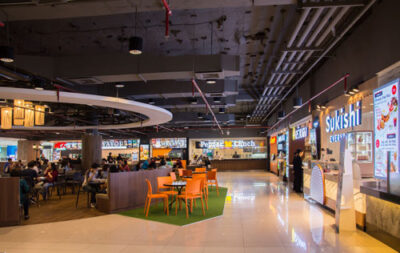
Everyone’s, which in practice means it needs agreeing in advance. Raleigh’s downtown food halls put multiple independent kitchens into converted warehouse space — Transfer Co. runs to more than 50,000 square feet, Morgan Street lists over 20 vendors — and where stalls share a duct or a fan, the shared section is only as clean as the heaviest user on it. We clean the shared run once and document it for each operator rather than pretend the grease stops at a lease line.

Can you work late? Glenwood South doesn’t close early.

We work after last service and early morning as standard. Downtown Raleigh carries around 289 restaurants and bars, and the Glenwood South and Warehouse District venues in particular trade late into the night. An evening shutdown to clean a hood costs far more than the clean does.

We’re opening a new kitchen. When should the first cleaning happen?

Later than you think, but the planning starts earlier. Your exhaust system goes through the fire marshal’s plan review before it is built, and the office reviews fire protection systems as part of that. The first service then comes once you are actually cooking and have a few weeks of real volume behind you — that is what establishes which interval you belong in, rather than a guess made before you opened. If your ductwork went in without proper access panels, that is also the moment to find out, while it is still cheap to fix.