
"*" indicates required fields
Tri-Cities Kitchens Run on Their Own Schedule. We Work Around It.
Downtown Johnson City packs a lot of kitchens into a small footprint, which usually means shared rooftop space and duct routing that is harder to reach than the hood suggests. Campus and hospital dining run volume year-round with no window for an outage. Kingsport’s Broad Street restaurants and the industrial cafeterias feeding the Eastman corridor turn out thousands of covers a week on equipment that never gets a slow month. And Bristol swings hard around race weeks, when hotel kitchens and concession operations go from steady to overwhelmed inside forty-eight hours, then drop back again.
The Tri-Cities sit inside our regular service area, not outside it. Restaurants, hotels, hospitals, schools and manufacturing cafeterias here are all on the same rotation as our Chattanooga and Knoxville accounts, cleaned overnight or early morning so the line is cold and the kitchen is ready for the next shift. We also cover Elizabethton, Greeneville, Jonesborough, Blountville and Erwin on the same routes.
What NFPA 96 Requires of a Tri-Cities Operator
NFPA 96 sets cleaning frequency by cooking type and volume. Solid-fuel equipment — wood, charcoal, a smoker out back — is monthly. High-volume kitchens are quarterly. Moderate-volume, full-service restaurants are semiannual. Low-volume operations like churches, seasonal venues and day camps are annual. Those are minimums rather than targets: a charbroiler running twelve hours a day can push a kitchen onto a shorter cycle than its category implies.
Fire officials across Washington, Sullivan, Carter, Unicoi and Greene counties enforce those intervals against the cleaning label on your hood, and your insurance carrier will ask for the same records after any loss. We assess your system before setting an interval rather than putting every kitchen on quarterly and billing accordingly. The standard itself is summarized on our NFPA 96 page.
The Whole System, Every Visit
Grease travels, and it settles heaviest in the horizontal duct runs and inside the fan housing on the roof — the parts a partial cleaning never reaches, and the first parts a fire marshal checks when he opens an access panel.
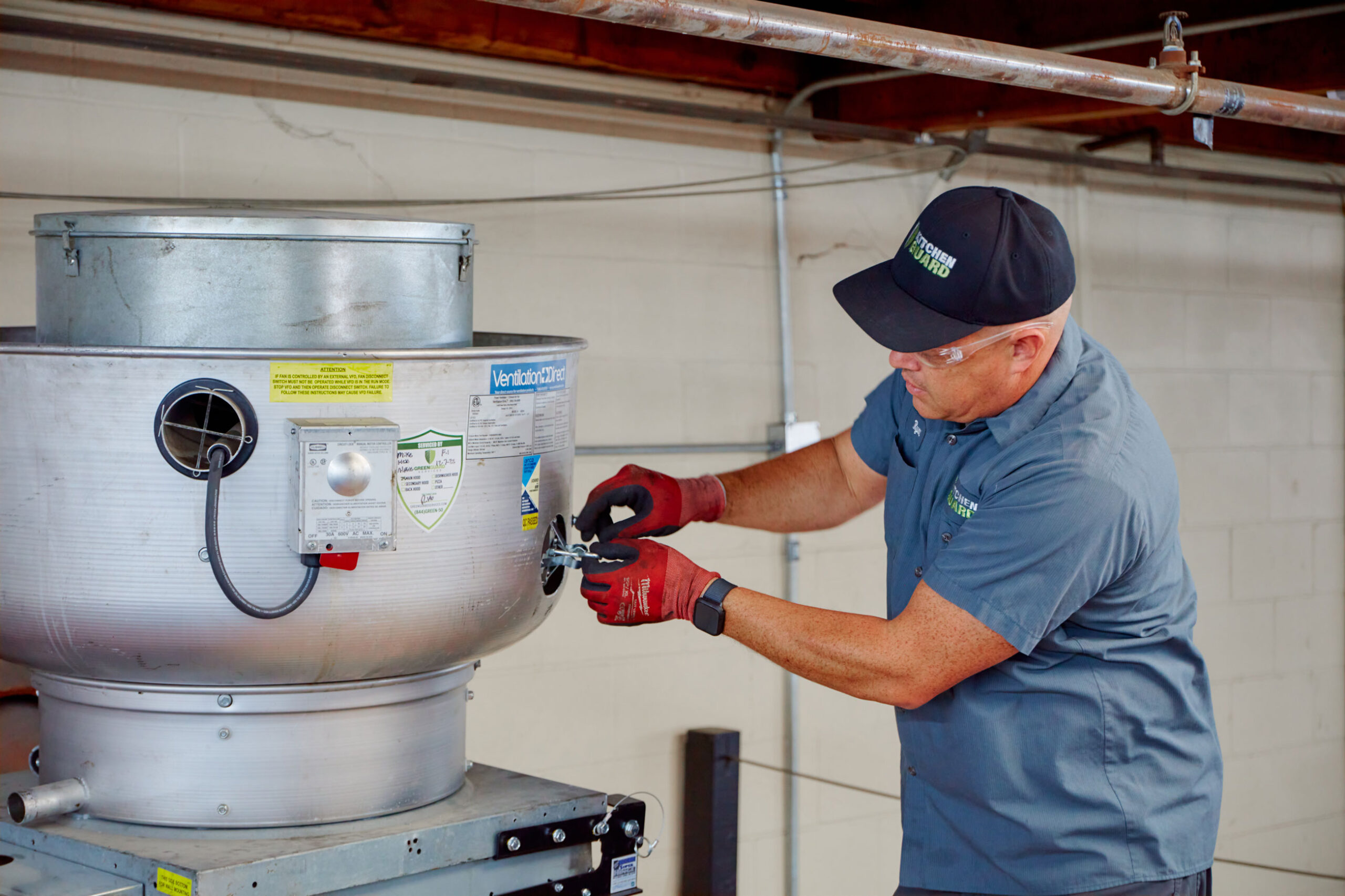
Every visit covers the canopy and baffle filters, the plenum behind them, the complete horizontal and vertical duct network, every access panel along the way, and the exhaust fan itself, using commercial-grade pressure washing equipment and cleaned to the NFPA 96 standard local inspectors actually enforce. If your system does not have enough access panels to reach a duct section properly, we tell you rather than cleaning what is easy and calling it compliant. That is how a system that looks spotless from the kitchen floor still fails an inspection.
One Visit Instead of Four
Most Tri-Cities sites would rather absorb one access disruption than four. We can pair your cleaning with hood filter exchange, exhaust system repairs, or commercial pressure washing of your back-of-house, dock and dumpster areas, so a single scheduled window covers the whole list and the roof gets one trip instead of several.
Who We Serve in the Tri-Cities
Restaurants and breweries, where fire code and an inspection date you did not pick are the same exposure whether you run one location or twenty. Hotels and event venues, where breakfast service runs every day of the year and banquet kitchens surge for conventions, weddings and race weekends. Hospitals and senior living, where a kitchen outage is a patient care problem rather than an inconvenience. K-12 and university dining, cleaned around academic calendars and summer shutdowns. Manufacturing and corporate cafeterias, where a cafeteria going dark ripples through every shift in the building.
Who Does the Work, and What You Get Back
The people cleaning your system are certified, safety-trained W2 employees of Kitchen Guard. We do not subcontract, so accountability for the work stays with us rather than shifting to a third party you never hired. Crews are fully insured and bonded.
Every service produces HD before-and-after photographs of the canopy, filters, duct interior, access points and the fan, plus a written service report naming the technician who did the work and the date it was done, and an updated compliance label on the hood. All of it is delivered through an online client portal, so when a fire marshal, health inspector or insurance carrier asks how the system is maintained, the record is already in hand instead of something you reconstruct under pressure. Kitchen Guard of East Tennessee is locally owned and operated out of our Chattanooga shop.
Tri-Cities Hood Cleaning Questions We Actually Get
No. Our routes run from Chattanooga north through Cleveland, up I-75 to Knoxville and on into Upper East Tennessee. If your kitchen sits anywhere along that corridor you are inside our regular service area, not a special trip we quote extra for.
Your interval comes from NFPA 96 and does not change by city, but who shows up and what they want to see does. Johnson City, Kingsport and Bristol each run their own fire department inspections, and operations outside city limits in Sullivan, Washington or Carter County fall under different coverage again. We keep the documentation format consistent across all of them, so you are never scrambling to produce something in a format one inspector wants and another does not.
As far ahead as you can. Hotel, concession and restaurant kitchens across Bristol and Kingsport all want to be clean going into a race weekend and clean again coming out of one, which compresses a month of demand into two narrow windows. If your operation swings with the Speedway calendar, tell us at the walkthrough and we will build those dates into your rotation instead of treating them as rush requests.
Usually the roof. When a crew is absorbing a long drive, the fan housing and the horizontal duct runs are the first things that get skipped, because nobody in the kitchen will ever see them. On a first visit we photograph the fan and the duct interior before we touch anything, so you can see the actual starting condition rather than take our word for what the last company missed.
Yes, and it is usually simpler and cheaper per site. Multi-unit operators across Johnson City, Kingsport and Bristol go on a single rotation with one point of contact and one portal login, with dates staggered so no two locations are disrupted in the same week. Our 24-month service plans are built the same way.
Call 423-275-6273 and tell us the deadline. A failed inspection is a scheduling problem with a hard date attached, and we would rather move a route than watch a Tri-Cities kitchen sit closed. We will clean the full system, document it, and give you a report and photographs you can hand directly to the inspector.

Book a Tri-Cities Kitchen Exhaust Cleaning
Serving Johnson City, Kingsport, Bristol, Elizabethton, Greeneville, Jonesborough, Blountville and Erwin. Call 423-275-6273 or schedule a consultation and we will walk your system, set an interval that matches how you actually cook, and put it in writing.