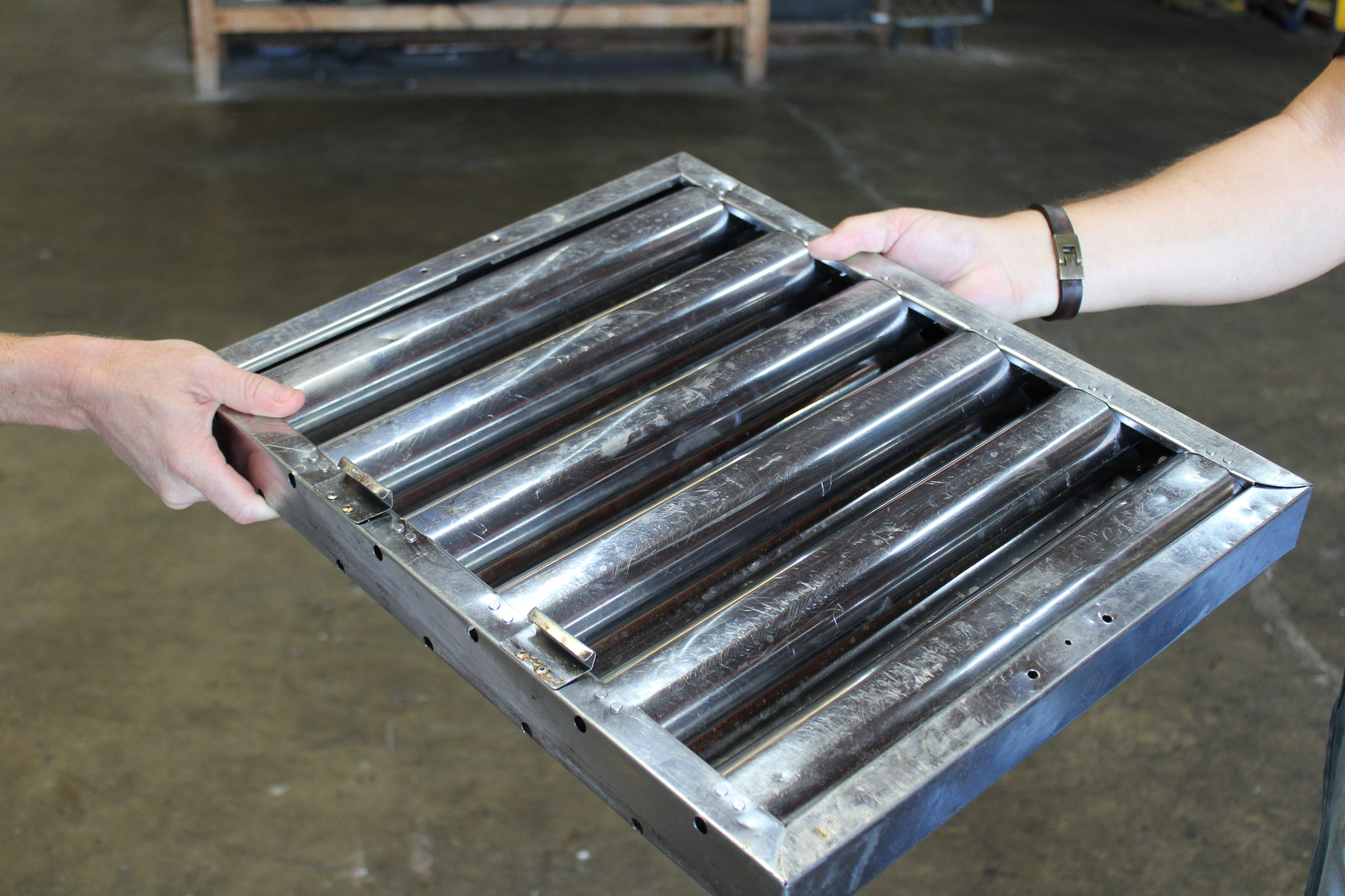
Baffle vs. Mesh Hood Filters: What Belongs Over Your Cook Line
Most operators inherit their filters. The hood came with the building, the last cleaner put back whatever was already in it, and nobody asked whether those filters were the right ones for the appliances underneath. That is worth an hour of your attention, because filter type is not a matter of preference. It decides how much grease is captured over your cook line and how much of it ends up coating the inside of your duct.
Why filter type is a code question, not a preference
NFPA 96 treats grease filters as fire-protection equipment rather than consumables. They have to be listed for the job, installed the way the standard specifies, and maintained so grease never builds past the point the code allows. A filter bank that fails any one of those three tests is a finding on your inspection, even when the hood looks spotless from the kitchen floor.
What a baffle filter actually does
A baffle filter is a set of stainless channels that force air to change direction sharply on its way into the plenum. Grease droplets are heavier than the air carrying them, so they cannot make the turn. They strike the metal, condense, and drain down into the trough instead of continuing up the duct. There is nothing to clog and nothing to burn: the filter is solid metal with open channels, so airflow stays predictable as grease loads, and a set that has been degreased properly performs like a new one.
Why mesh does not belong over a cook line
Mesh filters capture grease by holding it inside layered material rather than draining it away, and two problems follow. Airflow chokes as the mesh loads, so the hood pulls less air and your exhaust fan works harder against the restriction. And the trapped grease sits in a saturated medium directly above an ignition source, which is the exact condition the standard is written to prevent. If you have mesh over a grease-producing appliance, treat it as a defect to correct rather than a maintenance item to schedule.
The listing label is the part an inspector checks
Listed grease filters carry a permanent label showing the listing mark. That label is what turns “these look like baffle filters” into evidence, and it is why the cheap unlabelled sets available online are a poor trade: you cannot demonstrate compliance with a filter that cannot identify itself. Check the edge of each filter in your bank. If some are labelled and some are not, you have a mixed bank and a documentation problem.
Installation details that fail inspections
Right filters, wrong installation, same result. Filters have to sit at the angle the standard requires rather than lying flat, so captured grease actually drains. The drainage path has to lead somewhere that gets emptied, not onto a ledge. The bank has to be full and tight, because a missing filter, a warped frame or a gap between two filters is an open bypass straight into the ductwork and grease will find it immediately. And every filter has to lift out by hand for cleaning without tools or contortion, because a filter nobody can remove is a filter nobody cleans.
Charcoal and spark arrestors are a different job
If you are cooking over wood or charcoal, filters are not the whole conversation. Solid-fuel systems carry their own requirements, including spark arrestors ahead of the grease filters. Our guide to solid fuel hood cleaning and spark arrestor filters covers that separately.
If you have inherited the wrong filters
The fix is usually straightforward. Identify what is actually in the hood, replace anything unlisted or damaged with correctly sized listed baffle filters, and then keep them on a schedule instead of a hope. That is what our hood filter exchange program is for: two sets in rotation, cleaned off site, swapped on a set interval. If grease has already travelled past the filters into the duct, commercial hood and exhaust cleaning is the other half of the job.
We handle filters for restaurants, schools, hospitals and hotels from Chattanooga and Cleveland through Knoxville and up into the Tri-Cities. If you are not sure what is sitting over your line, send us a photo of the filter bank and we will tell you what you are looking at, or contact our East Tennessee team for a per-filter quote.
| Comparison | Baffle filter | Mesh filter |
|---|---|---|
| How it captures grease | Inertia: air changes direction, grease drains out | Absorption: grease is held inside the material |
| Airflow as it loads | Stays close to consistent | Drops steadily, straining the fan |
| Cleanability | Fully degreased off site, reused for years | Difficult to fully clean, degrades |
| Standing under NFPA 96 | Listed types are the accepted device | Not appropriate over grease-producing appliances |