
"*" indicates required fields
Commercial Pressure Washing for DMV Restaurants: Dumpster Pads, Concrete, Building Exteriors & More
What Is Commercial Pressure Washing — and Why Does It Matter for DMV Restaurants?
Commercial pressure washing is the professional, high-pressure deep cleaning of exterior and semi-exterior surfaces at restaurants, hotels, and commercial kitchens. It removes baked-on grease, carbon buildup, food waste, mold, biological matter, and staining from concrete, asphalt, brick, metal, and other hard surfaces. It is not a garden hose. It is not a consumer pressure washer from Home Depot. Done correctly, it requires commercial-grade hot-water equipment, EPA-compliant degreasers, and — critically in Washington DC, Maryland, and Virginia — full wastewater containment and reclamation.
For DMV restaurant operators, commercial pressure washing is not optional. Dirty dumpster pads, grease-stained loading docks, and buildup on exterior walls are among the top triggers for failed health inspections, rodent infestation reports, pest control violations, and neighbor or tenant complaints. DC DOEE, the Maryland Department of the Environment, and Virginia DEQ all prohibit untreated grease-contaminated wastewater from entering storm drains. Restaurants that pressure wash without proper containment equipment are in direct violation of Clean Water Act provisions — regardless of whether a health inspector is watching.
Kitchen Guard of DMV brings commercial-grade hot-water pressure washing equipment and full wastewater reclamation to every job. Every drop of contaminated runoff is captured, collected, and disposed of through licensed grease haulers — not through your drains, not into the street, and not into the DC storm sewer system.
Dumpster Pad & Enclosure Cleaning in DC, Maryland & Virginia
Your dumpster pad is the dirtiest exterior surface at your restaurant — and the one health inspectors, pest control officers, and fire marshals check first. Grease, food waste, blood, and biological matter pool in the concrete or asphalt under your dumpster enclosure and begin breaking down immediately. The result: foul odors that reach your dining room, flies and cockroaches that trace straight back to your kitchen entrance, and health code violations that can shut your operation down.
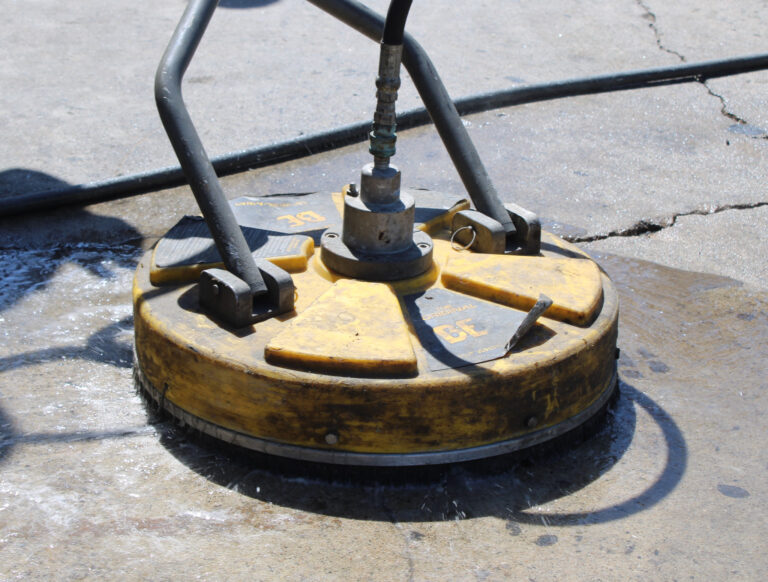
Kitchen Guard’s dumpster pad cleaning service removes all organic buildup from your enclosure area using high-heat pressure washing and EPA-approved degreasers, with full wastewater containment so nothing runs into adjacent areas or storm drains. We leave your dumpster pad compliant, odor-free, and ready for your next health or fire inspection — not just visually cleaner, but actually sanitized.
What Hoodz calls “looking like new” is cosmetic. What Kitchen Guard delivers is documented, EPA-compliant cleaning by certified employees who understand the difference between a clean-looking pad and a compliant one.
Concrete & Asphalt Cleaning for DMV Commercial Kitchens
Loading docks, service corridors, kitchen aprons, and sidewalks around your restaurant accumulate grease drips, cooking oil spills, foot traffic contamination, and biological buildup faster than almost any other surface. In Northern Virginia and Maryland, these surfaces are also subject to Chesapeake Bay watershed stormwater regulations — meaning untreated runoff from even routine cleaning operations can trigger DEQ or municipal stormwater permit violations.
Kitchen Guard’s concrete and asphalt cleaning uses commercial-grade hot-water equipment (not cold-water residential washers) to break through polymerized grease layers that cold water simply cannot dislodge. Surface temperature matters: hot water saponifies grease on contact, reducing chemical usage and improving removal. Our technicians use surface containment barriers and wet-vac reclamation on every concrete cleaning job to ensure zero contaminated runoff — protecting your DC, Maryland, or Virginia stormwater permit compliance and your business license.
Commercial Pressure Washing for Building Exteriors & Walls
Grease vapor from exhaust stacks, carbon deposits from rooftop fan discharge, and general urban grime accumulate on your building’s exterior walls, awnings, HVAC enclosures, and make-up air units. These deposits are not just cosmetic — they contribute to facade deterioration, indicate exhaust system issues to health inspectors, and signal poor kitchen maintenance to customers walking past your entrance.
Kitchen Guard pressure washes exterior walls, awnings, loading bay doors, and building facades using appropriate pressure settings and chemistry for each surface type. We do not use one-size-fits-all settings — brick, stucco, metal panels, and painted surfaces each require different pressure and temperature profiles to clean effectively without surface damage. Every job is documented with before-and-after photos.
Why Kitchen Guard Beats Hoodz on Commercial Pressure Washing in the DMV
Hoodz uses the phrase “local crews” — which means subcontractors. Independent workers they recruit franchise-by-franchise who are not direct Hoodz employees, are not trained to a national standard on-site, and whose compliance practices vary from crew to crew. When a Hoodz subcontractor cuts corners on wastewater containment at your DC restaurant, it is your EPA violation — not theirs.
Kitchen Guard of DMV employs every technician directly. That means every pressure washing crew that shows up at your restaurant is background-checked, trained to our compliance standards, and accountable to Kitchen Guard management — not to a staffing agency. Our wastewater reclamation protocol is the same on every job, every time, because our technicians are ours — not rotated subcontractors from a franchise network.
And because Kitchen Guard also performs your hood cleaning, filter exchange, and exhaust fan repairs, our pressure washing technicians understand your exhaust system. When they clean your rooftop fan surround or grease containment area, they know what they are looking at — and they flag issues the way a vendor who only pressure washes never would.
Full-Service Exterior Cleaning — Every Surface, Every Visit
Kitchen Guard’s commercial pressure washing covers every grease-impacted exterior at your DMV restaurant:
- Dumpster pads and enclosures — EPA-compliant cleaning with full wastewater reclamation; rodent and odor elimination
- Loading dock areas and service entrances — grease and food waste buildup removed from all approach surfaces
- Concrete aprons and sidewalks — Chesapeake Bay-compliant cleaning; slip hazard and health violation elimination
- Building exterior walls and awnings — carbon and grease vapor deposits from exhaust stacks; facade preservation
- Rooftop fan surrounds and grease containment areas — connected to your exhaust system compliance; fully documented
- HVAC enclosures and make-up air unit exteriors — often overlooked, frequently flagged in health inspections
- Grease trap surrounds and utility zones — highest EPA sensitivity; full containment required and provided
- Kitchen entrance areas and employee entrances — health code-sensitive zones with biological and food waste buildup
How Often Do DMV Restaurants Need Pressure Washing?
Frequency depends on your kitchen’s volume, menu type, and local regulatory environment:
Monthly: High-volume DC restaurants, 24/7 operations, hotel kitchens, sports venues, event spaces, government cafeterias
Quarterly: Full-service restaurants and bars, corporate cafeterias, healthcare facilities in Northern Virginia and Maryland
Semi-Annually: Lower-volume cafes, office cafeterias, seasonal operations, senior living facilities
Kitchen Guard will assess your facility and set the right schedule — not the most frequent one, and not a one-size-fits-all franchise contract.
DMV Commercial Pressure Washing Service Areas
Kitchen Guard of DMV provides commercial pressure washing to restaurants, hotels, schools, healthcare facilities, government buildings, and commercial kitchens throughout: Washington DC (all neighborhoods, Embassy Row, Capitol Hill, Georgetown, Navy Yard, NoMa, Dupont Circle, government facilities), Northern Virginia (Alexandria, Arlington, Fairfax, Reston, McLean, Tysons Corner, Falls Church, Herndon, Manassas, Woodbridge, Annandale), and Maryland (Bethesda, Rockville, Silver Spring, College Park, Annapolis, Upper Marlboro, Waldorf, Laurel, Bowie, Capitol Heights, Greenbelt, Hyattsville).
Kitchen Guard of DMV also provides commercial hood cleaning and commercial hood filter exchange — so your entire kitchen compliance program, from exhaust system to exterior surfaces, is managed by one certified team.
NFPA 96 Compliance & Related Kitchen Services
Pressure washing works hand-in-hand with commercial hood cleaning and filter exchange to keep your kitchen exhaust system fully compliant with NFPA 96 requirements in Washington DC, Maryland, and Virginia.
We serve restaurants and commercial kitchens across the DMV:
Washington DC | Arlington VA | Alexandria VA | Bethesda MD | Rockville MD | Silver Spring MD | Fairfax VA
Frequently Asked Questions About Commercial Pressure Washing in DC, Maryland & Virginia
Real questions from DC, Maryland, and Virginia restaurant operators — answered by our local DMV pressure washing team.
Kitchen Guard’s DMV-based technicians use high-heat, high-pressure water with commercial-grade degreasers to break down grease on exterior surfaces. Unlike Hoodz’s subcontracted crews using generic cold-water equipment, Kitchen Guard employs every technician directly and includes full wastewater reclamation on every job — capturing all contaminated runoff before it reaches DC, Maryland, or Virginia storm drains. Every service includes written documentation for your health inspector compliance records.
Yes. Grease-contaminated wastewater runoff is regulated under the Clean Water Act and enforced locally by DC DOEE, Maryland MDE, and Virginia DEQ. Standard cold-water pressure washing — like Hoodz uses — pushes contaminated runoff directly into storm drains, creating potential EPA fines. Kitchen Guard’s wastewater reclamation system captures all contaminated water before it reaches a storm drain on every job. We provide written service documentation after every visit — your compliance record for DC, Maryland, and Virginia health inspectors.
Most DC and Northern Virginia high-volume restaurants we serve schedule monthly. Full-service suburban Maryland and Virginia restaurants, breweries, and hotel kitchens typically schedule every 6–8 weeks. Lower-volume operations, cafes, and office buildings generally do quarterly. Dumpster pads almost always need more frequent service — particularly through DC and Maryland’s warmer months when heat accelerates grease breakdown and odor. Kitchen Guard assesses your specific operation and recommends the right cadence to keep you inspection-ready year-round.
Kitchen Guard pressure washes all high-risk exterior surfaces for DMV restaurants: dumpster pads and enclosures (the most commonly cited exterior violation in DC and Maryland inspections), back dock and service entrances, customer-facing sidewalks and walkways, outdoor patio and dining areas, drive-through and loading areas, and grease trap surroundings. All services include full wastewater reclamation — no contaminated runoff into DC, Maryland, or Virginia storm drains.