How Often Should a Commercial Kitchen Hood Be Cleaned? A Franklin, TN Operator’s Guide
The Short Answer, and Why It Is Not One-Size-Fits-All
For most Franklin kitchens, exhaust cleaning frequency falls somewhere between monthly and semi-annually. A high-volume steakhouse running a charbroiler needs far more frequent attention than a small cafe that plates cold sandwiches and runs the fryer twice a day. The reason is grease. Every cooking process throws grease-laden vapor into the hood, and the heavier and greasier the cooking, the faster that vapor coats the inside of the system. Frequency is really a question of how quickly your particular kitchen rebuilds a grease layer, and that is why a good provider sets the interval after seeing the system, not from a generic default.
How NFPA 96 Frames Cleaning Frequency
NFPA 96 is the national standard behind nearly every commercial kitchen exhaust inspection, and it ties cleaning to the presence of grease rather than to the calendar alone. The standard calls for the system to be inspected at intervals appropriate to the type of cooking and cleaned wherever grease has accumulated. You can review the standard on the NFPA 96 standard page. The practical translation for a Franklin operator is that the code does not hand you a fixed date. It hands you a duty to keep the interior clean, and it expects the cleaning interval to reflect how hard the system works. Our commercial hood cleaning service is built around that principle.
This is an important distinction, because it shifts the question from “how do I hit the minimum required date” to “how do I keep grease from ever building to a dangerous level.” Those are not the same goal. A kitchen that treats the interval as a box to check will always run closer to the edge than one that treats a clean interior as the actual objective. The inspection schedule NFPA 96 references exists precisely so that the right cleaning interval gets caught before grease accumulates, rather than after. A qualified provider uses that inspection step to adjust your cadence as conditions change, which is what keeps a schedule accurate over time instead of frozen at whatever number was set on day one.
Cleaning Frequency by Cooking Volume
The table below reflects the NFPA-aligned cadence we use as a starting point when we assess a Franklin kitchen. Think of these as the opening position, refined once a technician sees your actual grease load.
| Cooking profile | Examples | Suggested frequency |
|---|---|---|
| High-volume, high-grease | Charbroiling, wok cooking, solid fuel, 24-hour operations | Monthly |
| Moderate-volume | Full-service sit-down restaurants, hotel and hospital kitchens | Quarterly |
| Low-volume | Churches, seasonal venues, day cafes, light reheat kitchens | Semi-annually |
These intervals are guidance, not guarantees. A kitchen that sits on the line between two categories should generally choose the shorter interval, because the cost of cleaning slightly more often is small next to the cost of a failed inspection or a duct fire.
What Drives Your Kitchen Into a Shorter Interval
Two Franklin restaurants of the same size can need very different schedules. These are the factors that push a kitchen toward more frequent cleaning.
1. Cooking Method and Grease Output
Charbroiling, wok cooking, and frying throw far more grease into the air than baking or steaming. A kitchen built around a flat-top and a charbroiler will coat its ducts several times faster than one that mostly plates cold or oven-finished dishes. The cooking method is the single biggest driver of frequency.
2. Hours of Operation
A system that runs sixteen hours a day accumulates grease roughly twice as fast as one running eight. Late-night kitchens and 24-hour operations compress months of buildup into weeks, and their schedules need to reflect that.
3. Menu and Seasonal Swings
Menus are not static, and neither is grease output. A patio-driven Franklin spot that leans into grilled items all summer produces more grease in its busy months, and a holiday catering push can spike volume for weeks. A schedule that ignores these swings will be too loose, exactly when the risk is highest.
4. The Age and Layout of Your System
Older buildings and converted spaces often have long, winding duct runs with many horizontal sections where grease settles. More horizontal footage means more places for buildup and a stronger case for a tighter interval, regardless of cooking volume.
Signs Your Franklin Kitchen Is Overdue
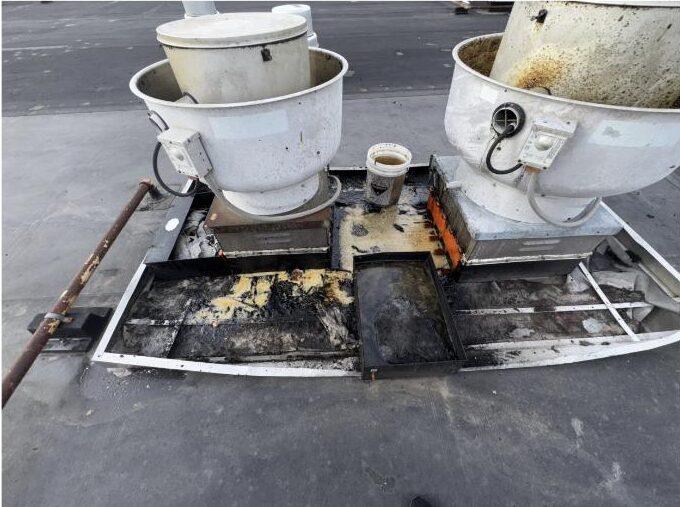
Even on a schedule, it helps to recognize the warning signs that your cleaning interval is too long. Watch for grease dripping at hood seams or filter edges, a burnt or stale odor lingering in the dining room, filters that are saturated within days of cleaning, reduced airflow that leaves heat and smoke hanging over the line, and visible grease on the roof near the fan. Any of these means the system is loading faster than the current schedule handles, and is an indication to schedule cleaning more often.
It is worth training your closing staff to notice these signs and report them, because the people on the line every night will see the change before it shows up on an inspection. A filter that used to stay clean for a week and now looks saturated in two days is telling you the grease load has climbed. Treat that as data. It usually means the kitchen has gotten busier, changed its menu, or added a greasier cooking process, and the schedule should catch up to match. Catching the shift early costs a phone call. Missing it can cost a failed inspection or an emergency cleaning at a premium.
Who Sets the Rules in Franklin and Williamson County
In Franklin, commercial fire and life safety inspections run through the Franklin Fire Marshal’s Office, which enforces the adopted fire code for existing and new occupancies within the city. Kitchens in the surrounding unincorporated areas of Williamson County fall under the county’s fire code authority. Statewide, the framework traces back to the Tennessee State Fire Marshal’s Office within the Department of Commerce and Insurance. For a Franklin operator, the inspector who walks your kitchen is applying that adopted code, and their expectations for a clean, documented exhaust system are the ones your schedule needs to satisfy.
Why “When It Looks Dirty” Is the Wrong Trigger
Waiting until the hood looks bad means waiting until grease has already built well past the safe point, because the dangerous buildup is inside the ducts and on the fan where you cannot see it. The stakes are not abstract. The U.S. Fire Administration reports that cooking causes roughly 64 percent of restaurant fires, and a hood that looks acceptable from the floor can still have a heavy grease layer feeding the duct above it. A schedule based on a visible cue is always a step behind the actual risk. A schedule based on cooking profile stays ahead of it.
The Cost of Cleaning Too Little
Stretching the interval to save money usually backfires. Grease that is allowed to build becomes a continuous fuel layer in the ducts, which raises the odds of a fire that spreads beyond the kitchen. It also loads the exhaust fan, forcing the motor to work harder and shortening its life. And it sets up the inspection problem: a marshal who finds heavy interior grease can issue a violation that triggers a reinspection and, in a bad case, an operational hold. The savings from a skipped cleaning are small and temporary. The costs, when they land, are neither.
There is also a downtime cost that operators tend to overlook. A failed inspection or an emergency cleaning almost always lands at the worst possible time, and it can force you to close the kitchen or pull the line out of service during business hours. A cleaning done on a planned overnight schedule is invisible to your guests. A cleaning forced by a violation is not, and it can cost you a full service period on top of the cleaning itself.
How Cleaning Frequency Affects Your Insurance
Beyond the fire marshal, your insurer has a stake in how often your exhaust system is cleaned. Many commercial property and liability policies for restaurants expect the kitchen exhaust system to be maintained to a recognized standard, and a serious grease fire followed by no service records can complicate or jeopardize a claim. When a fire investigator can trace the ignition to a neglected, grease-laden duct, the absence of a maintenance history becomes a problem at exactly the moment you can least afford one. A consistent cleaning cadence backed by documentation is not only a fire-code matter, it is part of protecting the coverage you already pay for. For a Franklin operator, keeping a clean service history is one of the cheapest forms of risk management available, and it costs nothing beyond staying on the schedule you should already be keeping.
The Cost of the Wrong Kind of Cleaning
Frequency is only half the equation. A cheap provider who cleans only the visible hood on a perfect schedule still leaves your ducts and fan loaded with grease, which means you are paying for compliance you do not actually have. The right cleaning reaches the full system every visit, from the canopy through the ductwork to the fan and rooftop. When you evaluate cost, compare full-system cleanings to full-system cleanings, not a complete service against a spot wipe that happens to be cheaper.
The trap is that a partial cleaning looks identical to a complete one from the dining room floor. The hood shines, the kitchen smells better for a few days, and the invoice is lower, so it feels like a smart buy. The problem only surfaces when an inspector opens an access panel, or worse, when a duct fire starts in grease that a full cleaning would have removed. A Franklin operator who chooses a provider on price alone can end up paying twice: once for the incomplete service, and again for the emergency cleaning or repair that follows. The cheaper interval is only cheaper if the work behind it is real.
Where Filters Fit Into the Schedule
Grease filters are the part of the system you can influence between full cleanings, and they matter more than most operators realize. Clean filters capture grease at the source and protect the ducts; saturated filters let grease through and drop your airflow. A hood filter exchange program keeps fresh filters in rotation by swapping dirty ones for cleaned spares on a set schedule, which slows how fast the ducts load and takes end-of-shift filter scrubbing off your staff’s plate. Well-managed filters can help a kitchen hold a stable cleaning interval instead of drifting toward a shorter one.
Common Myths About Cleaning Frequency
A few persistent misunderstandings lead Franklin operators to clean less often than they should. It is worth naming them directly.
The first myth is that a newer hood needs cleaning less often. Age has little to do with it. A brand-new system in a high-volume charbroiling kitchen builds grease just as fast as an old one, because frequency is driven by cooking output, not equipment age.
The second myth is that a quiet season means the schedule can slide. Reduced hours do lower grease output, but a system that ran hard all summer still carries the buildup from those months into the fall. The schedule should reflect the busy stretch, not the slow week you happen to be in when you think about it.
The third myth is that a self-cleaning or “grease-reducing” hood eliminates the need for professional service. These features can help at the capture point, but they do not clean the horizontal ducts, the fan, or the rooftop, which is exactly where NFPA 96 and your inspector are focused.
The fourth myth is that if the kitchen passed its last inspection, the current schedule must be fine. An inspection is a snapshot. A kitchen that has since added a fryer or extended its hours can be well past due even though the paperwork from six months ago looks clean.
What a Cleaning Actually Covers at Each Visit
When frequency is right and the work is thorough, each visit resets the whole system. A complete hood and exhaust cleaning addresses:
- The hood canopy and capture area
- The grease filters, cleaned or exchanged
- The horizontal and vertical ductwork, cleaned to bare metal
- The exhaust fan housing and blades
- The rooftop termination and grease containment
- A written record and before and after photos
Every one of these points is somewhere grease collects, and skipping any of them undermines the whole schedule. Frequency and scope work together: the right interval on an incomplete cleaning is still an incomplete cleaning.
How Documentation Ties to Frequency
A cleaning schedule is only as credible as the records behind it. Each Kitchen Guard of Nashville visit produces a Post Service Report showing what was cleaned and when, with before and after photos available on request. Over time those reports build the service history that proves to a Franklin inspector, and to your insurer, that the system has been maintained on a compliant cadence. The initial inspection that scopes a job is internal and informs your quote; the Post Service Report is the record you keep. A consistent interval with consistent documentation is what turns “we clean it regularly” into something you can actually demonstrate.
Building the Right Schedule for Your Kitchen
Setting frequency is a short process when it is done properly. These three steps get a Franklin kitchen to the right interval.
1. Start With a System Assessment
Before any number is set, a technician should see the hood, open access panels, and check the fan and roof. That assessment reveals the real grease load and the layout quirks that a generic schedule would miss.
2. Match the Interval to the Menu
Set the cadence to the cooking profile, then commit to reviewing it when the menu or hours change. A kitchen that adds a grill station or extends its hours should revisit the interval rather than assume the old one still fits.
3. Bundle Filters and Repairs Into the Plan
Fold filter exchange and any needed exhaust repairs, such as access panels or fan service, into the recurring plan so the system stays cleanable and nothing falls through the cracks between visits.What Kitchen Guard of Nashville Provides in Franklin
Our trained technicians assess your system, recommend a cleaning frequency matched to your cooking profile, and clean the full exhaust system to NFPA 96 standards at every visit. We exchange filters, handle repairs as they surface, and provide a Post Service Report with photos so your compliance is documented. You can see the full scope of what we offer on our services page, and every relationship begins with a complimentary inspection so the schedule we recommend is based on your actual kitchen rather than a guess.
Serving Franklin and the Greater Nashville Area
Kitchen Guard of Nashville serves Franklin and communities across Middle Tennessee, including Nashville, Brentwood, Murfreesboro, Hendersonville, and Smyrna. Whether you run a single Franklin restaurant or a group of kitchens across the region, we set a cleaning frequency that fits each location and keep the documentation consistent across all of them. The right interval, the full-system cleaning, and the paperwork to prove it are the same standard everywhere we work.
Frequently Asked Questions
How often should a commercial kitchen hood be cleaned in Franklin?
Most kitchens fall between monthly and semi-annually. High-volume and high-grease kitchens generally need monthly cleaning, moderate-volume sit-down restaurants quarterly, and low-volume operations semi-annually. The right interval depends on your cooking method, hours, and system layout.
Does the type of cooking really change the schedule that much?
Yes. Charbroiling, wok cooking, and frying produce far more grease than baking or steaming, so grease-heavy kitchens load their ducts much faster and need more frequent cleaning.
Can I just clean the hood myself between services?
Wiping the visible hood helps appearance but does not address the ducts, fan, and rooftop where the fire risk actually sits. Those require professional full-system cleaning on a schedule.
How do I prove my kitchen is on a compliant schedule?
Keep the service records. Kitchen Guard of Nashville provides a Post Service Report after every visit, with photos, that you can show a Franklin inspector or your insurer.
What happens if I wait too long between cleanings?
Grease builds into a fuel layer in the ducts, raising fire risk, loading the fan, and setting up a possible inspection violation. Waiting rarely saves money once those costs land. According to NFPA 96, anything more than 5/64 fo an inch of grease is considered to be at high fire risk, that’s less than 1/8 of an inch.
Ready to Set Your Franklin Cleaning Schedule
If you are not sure whether your current interval fits your kitchen, the safest move is to have the system assessed and the schedule set to your actual cooking profile. Kitchen Guard of Nashville will evaluate your exhaust system, recommend the right frequency, and document every visit so you stay ahead of the fire marshal. Call 615-546-0037 to book your complimentary inspection, or reach us through our contact page to get on a schedule that fits your Franklin kitchen.