Tagged Out of Service Since June: What a Howell Kitchen Fire Should Teach Every Metro Detroit Operator
On the afternoon of September 10, crews from the Howell Area Fire Authority pulled up to the 200 block of East Grand River and found light smoke pushing from inside a downtown Italian restaurant and off the roof. The fire was in the commercial kitchen. Staff knocked it down themselves with multiple extinguishers before the fire department got water on it. Nobody was hurt, and the damage stopped at roughly $5,000 in contents.
By the numbers, that is a small fire. It is the sentence the fire chief said afterward that should stop every operator in Metro Detroit cold:
The hood suppression system was out of service, and had been tagged as such since June.
Three months of dinner service under a hood that could not fight back. The kitchen was preparing food for that evening when it lit. The building lost gas for the entire structure. The Livingston County Health Department came out. The city building department was notified. And on day one, Chief Andy Box put the closure at at least a week — with no reopening, in his words, until the fire suppression and ventilation systems are code-compliant again, as reported by WHMI.
Hold onto that second half of his sentence, because nearly everyone reads straight past it. Suppression and ventilation. The cylinder is only half of what has to be signed off before that kitchen cooks again. The other half is the hood itself — and a hood becomes a code problem through grease, not through a tag.
So the fire did $5,000. The tag is what closed the kitchen. But notice that the fire started anyway, under a hood, in a room that manufactures the one fuel a commercial kitchen produces every single service. That is the part worth your attention, and it is the part a suppression contract does nothing about.
This post is about that tag — what it is, who hangs it, what it legally obligates you to do the same day, and why the fix so often depends on a contractor most operators do not think of as part of their fire protection at all. If you want the separate question of what a hood fire actually does to a kitchen and a P&L, we covered that in what a hood fire costs a Detroit kitchen.
One system fights the fire. The other keeps it from starting.
It is worth being blunt about what a wet-chemical suppression system is, and what it is not.
It is a countermeasure. It sits above your line doing nothing at all until a fire is already burning — until a fusible link has reached its melting point, which is to say until there is already flame in the hood. Then it dumps agent onto the cooking surfaces, drops the fuel supply, and tries to keep a fire on the range from becoming a fire in the duct and then a fire in the building. That is a genuinely good outcome, and it is worth every dollar it costs. It is also, by definition, damage control. No restaurant has ever reopened faster because its suppression system worked. The best day a suppression system can give you looks a lot like Howell: a discharge, a closed kitchen, a cleanup, and a reinspection queue.
Hood cleaning works at the other end of the problem. Grease is the fuel. It condenses out of the air your fans pull off the line and plates itself onto the filters, the plenum, the duct walls and the fan housing — thin and tacky at first, then thick, then a continuous combustible lining running from your cooktop to your roof. Cleaning to bare metal removes that fuel. A flare-up in a clean hood is a flare-up. The same flare-up in a loaded duct is a structure fire, and the suppression system is the only thing standing between those two outcomes.
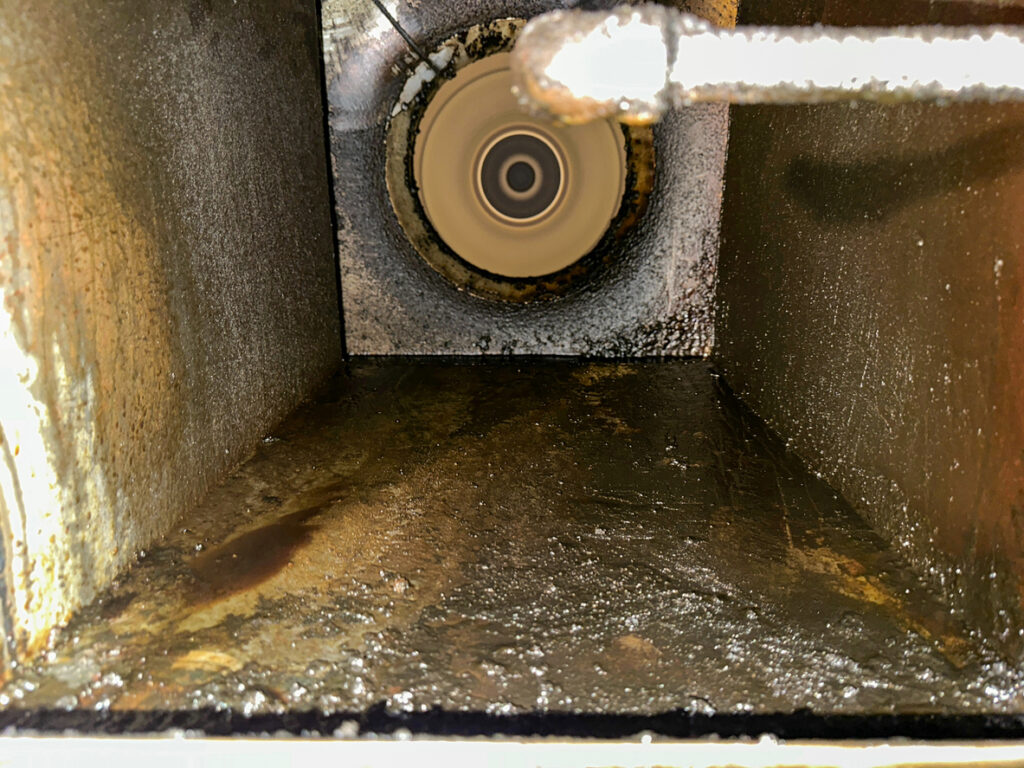
NFPA’s analysis of structure fires in eating and drinking establishments puts a scale on it: 7,410 of them a year, 61% involving cooking equipment, $165 million in direct property damage — and failure to clean was a factor in 22% of them. Better than one restaurant fire in five traces back to grease that should not have been there.
Which is why the order of operations in most kitchens is exactly backwards. The suppression inspection is the appointment that reliably lands on the calendar, because a contractor calls to book it and hangs a tag when he leaves. The cleaning is the thing that quietly stretches from quarterly to “whenever it starts to look bad,” because nothing hangs a tag when it slips. One of those two protects you every day. The other protects you on the worst day you will ever have.
The rest of this post is about the tag — but read it with that distinction in hand, because roughly half of what gets written up on a failed suppression inspection is not a suppression problem at all.
What “out of service” actually means
A hood suppression system is the wet-chemical system living above your line: a cylinder of agent, a length of pipe, nozzles aimed at each appliance, a detection line strung through the hood with fusible links in it, a manual pull station by the exit, and a mechanical or electrical gas shutoff. When a link melts — or somebody yanks the pull — the agent discharges onto the cooking surfaces, the fuel supply drops, and the fire is starved before it gets into the duct.
Note where most of that hardware lives. The detection line, the links and the nozzles are all inside the hood, in the airstream, in the grease. The readiness of your suppression system is downstream of how clean your hood is. That is not a rhetorical point — it is most of what follows.
Every six months, a licensed suppression contractor is supposed to take that whole chain apart and prove it still works. In Michigan, the firm doing that work has to be certified through the state’s Bureau of Fire Services under the Fire Prevention Code (Public Act 207 of 1941) — this is not work a handyman or your equipment tech can sign off on.
When the technician finds something that stops the system from doing its job, he does not get to leave and hope. He documents the deficiency, tells you, and tags the system. The tag is a physical card hung on the cylinder or the pull station saying, in effect: this system was inspected on this date, by this firm, and it is not in service.
Who hangs it, and who sees it
| Who | What they do with the tag |
|---|---|
| Your suppression contractor | Hangs it, writes the deficiency on the service report, and keeps a copy on file |
| Your fire inspector | Reads it on the next walkthrough. A current tag is the first thing most inspectors look for, because it is the fastest signal in the kitchen |
| Your insurance carrier | May ask for the service reports after a loss. A known, documented, uncorrected impairment is a hard conversation |
| Your staff | Usually nothing. Most line cooks have never been told what the tag on the cylinder means |
That last row is the one that turns a paperwork problem into a Howell-sized problem. The tag is hung in a corner of the kitchen where nobody looks, the manager who took the phone call has moved on, and the system quietly stays down through a change of season.
Why it is an occupancy problem, not a paperwork problem
Here is the part most operators have never been told. Under the fire code, a required fire protection system that is out of service is not simply a to-do item. The fire department and the fire code official are to be notified immediately, and until the system is back in service the building is either evacuated or covered by an approved fire watch — a person whose only job is to walk the space and call 911.
Read that again in the context of a restaurant. The suppression system over a Type I hood is a required system. If it is down and you are cooking, you are operating a building with a known impairment, without having told the authority having jurisdiction, and without a fire watch. That is the exposure — not the missing part, and not the $300 service call.
Most operators do not do this maliciously. They do it because nobody ever explained that a tag starts a clock.
Eight reasons a system gets tagged — and who actually fixes each one
Operators tend to assume a failed suppression inspection means a broken suppression system, and that the suppression company owns the fix. Often it does not. A meaningful share of deficiencies are conditions in the hood that the suppression technician can only write up, because correcting them is somebody else’s trade.
| What the inspector writes up | What it means | Whose fix it is |
|---|---|---|
| Fusible links past date | The links in the detection line are consumable. Metal-alloy links get replaced at least every six months; other types are examined or replaced annually | Suppression contractor |
| Nozzle caps missing or greased over | Blow-off caps keep grease out of the nozzle orifice. A plugged nozzle sprays nothing where it matters | Suppression contractor, but the grease is a cleaning problem |
| Nozzles no longer aimed at the appliance | Someone swapped a fryer for a griddle, or slid the line six inches. Coverage is designed appliance-by-appliance | Suppression contractor — requires a redesign, not an adjustment |
| Heavy grease in the hood, plenum or duct | Grease loading is both a fuel load and an obstruction. It coats links, caps and nozzles | Hood cleaning contractor |
| Filters missing, damaged, or the wrong type | Baffle filters are part of the system. Mesh filters, or gaps where a filter should be, let grease straight into the duct | Hood cleaning contractor / filter program |
| Access panels missing or screwed shut | If the duct cannot be opened and inspected, its condition cannot be verified | Hood cleaning or repair contractor |
| Exhaust fan not running, belt slipping or shot | An exhaust system that does not move air is its own code problem, and it drives grease where it does not belong | Repair contractor |
| Gas or electric shutoff fails to trip | The system has to kill the fuel when it discharges. A shutoff that does not trip is a failed test on its own | Suppression contractor |
Read that third column again. Four of the eight sit with the people who clean and maintain the hood, not the people who service the cylinder. That is why a kitchen can pass its suppression inspection in January, get tagged in July, and have nothing about the cylinder itself have changed. What changed was the grease.
Grease is the quiet common denominator. It coats fusible links so they run hot and slow — a link is a calibrated piece of metal, and insulating it in a brown shell changes when it lets go. It cakes over nozzle blow-off caps so the agent sprays somewhere other than where it was aimed. And it fills the plenum and the duct with the exact fuel the system exists to fight, so that on the day the system finally does discharge, it is fighting a bigger fire than it was ever designed for.
So cleaning is quietly doing two separate jobs, and operators usually only count the first. It removes the fuel, which is prevention — the fire does not start. And it keeps the suppression hardware in a condition where it will actually function, which is the difference between a system that has been inspected and a system that is ready. Keeping the hood, plenum and duct cleaned to bare metal on a real schedule is not a hygiene chore running alongside fire protection. For several of the line items above, it is the fire protection.
The filters deserve their own note. Filters are a wear part, and a bent or gapped baffle is a direct path for grease into the duct — which is to say, a direct path for fuel into the part of your building the suppression system cannot reach. Swapping them on a route, rather than degreasing tired ones in place, keeps a known-good filter in the rail every time — that is the whole idea behind a filter exchange program. Kitchen Guard does not clean filters on site; exchange is the service.
What Michigan actually requires
Michigan is not an International Fire Code state at the state level. The Bureau of Fire Services adopts NFPA 1, Uniform Fire Code, by reference in Mich. Admin. Code R 29.1652, and Detroit’s own fire prevention ordinance likewise runs on the NFPA fire prevention code. Some suburban jurisdictions in Oakland, Macomb and Wayne counties have adopted the IFC by local ordinance instead. Either way you land in the same place for a commercial kitchen, because both codes point at NFPA 96, Standard for Ventilation Control and Fire Protection of Commercial Cooking Operations, and the 2021 Michigan Mechanical Code governs the hood and duct themselves.
The practical requirements break into two separate clocks that operators routinely confuse. We are going to take them in the order that actually protects a kitchen — which is not the order most operators think of them in.
Clock one: the hood, plenum and duct
NFPA 96 sets inspection frequency for grease buildup by how hard the kitchen actually cooks — not by square footage, seats, or what the last guy scheduled.
| Type of cooking operation | Inspected at least | Typical Metro Detroit example |
|---|---|---|
| Solid fuel — wood, charcoal, mesquite | Monthly | Wood-fired pizza in Ferndale, charcoal grill houses, barbecue |
| High volume — 24-hour, charbroiling, wok | Quarterly | Coney islands, 24-hour diners, charbroil and wok lines |
| Moderate volume | Semiannually | Most sit-down restaurants, hotel and banquet kitchens |
| Low volume | Annually | Churches, senior centers, day camps, seasonal operations |
When cleaning happens, the standard is bare metal on every accessible surface — hood, plenum, duct, fan — and parts too grease-contaminated to restore get replaced rather than wiped. The contractor leaves a report showing the date, what was cleaned, what could not be reached, any deficiencies found, and who did the work, plus a sticker with the next service date. That report is the document your inspector and your carrier will ask for.
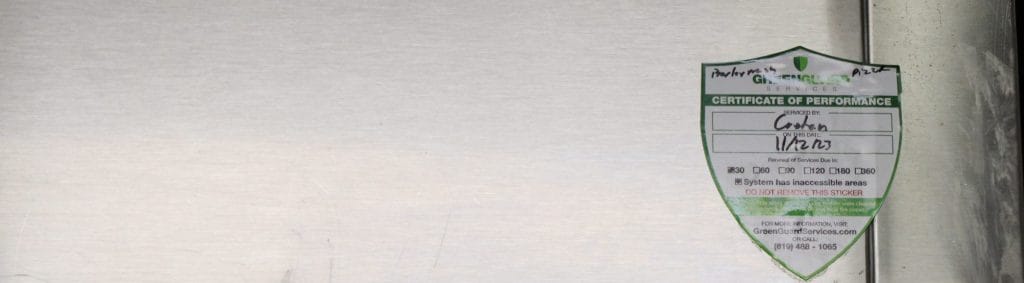
This is the clock that slips, and it slips for a structural reason: nothing hangs a tag when it does. A kitchen that is four months past a quarterly cleaning looks exactly like a kitchen that is on schedule, right up until a technician opens an access panel.
Clock two: the suppression system
The fire-extinguishing system is inspected and serviced by a trained, qualified, certified person at least every six months, and that service includes testing the actuation and control components, not just eyeballing the gauge. Metal-alloy fusible links are replaced at least semiannually. Your own staff should be checking the system monthly — gauge in range, manual pull unobstructed, nothing hanging off the nozzles — which is a five-minute walk, not a service call.
In Michigan, the firm performing that semiannual service must be certified through the Bureau of Fire Services. Ask for the certification number. It belongs on the paperwork.
Why the two clocks have to talk to each other
A kitchen on a quarterly cleaning schedule and a semiannual suppression inspection has its two contractors in the building on different months, looking at the same equipment, reporting to different people in your office. Neither one is responsible for the other’s findings. The gap between them is where a tag goes unnoticed for three months — and it is also where a cleaning interval quietly doubles.
The day your system gets tagged: what to actually do
Most operators treat a tag as a scheduling problem. It is closer to a shutdown decision, and the window to make it well is about an hour wide.
- Read the deficiency, out loud, to the person who can act on it. Not the ticket number — the actual finding. “Nozzle caps missing over the fryer bank” and “cylinder failed hydrostatic” are different emergencies with different answers.
- Ask the technician one question before he leaves the building: is this system capable of discharging right now, yes or no? A tag can mean anything from a due-date lapse to a system that will not fire. The technician knows which. Get the answer on the report, in writing.
- Ask him a second question: is this a cylinder problem or a hood problem? Roughly half of what gets written up is corrected by a cleaning crew rather than a suppression crew, and starting with the wrong phone call costs you days you do not have. See the table above.
- If the system cannot discharge, stop cooking under that hood. Not “finish the night.” The appliances under a dead system are the appliances the system exists for.
- Call your fire department’s fire prevention bureau and tell them. Volunteering an impairment is a very different conversation from having one discovered. Ask what they want from you while it is down — a fire watch, a cold menu, a reinspection on restoration. Get the name of who you spoke to.
- Call your insurance agent the same day. Carriers care a great deal about the difference between an unknown defect and a documented, uncorrected one.
- Get the correcting contractor scheduled before you hang up with the first one. If the deficiency is grease, filters, access panels or the fan, that is a different phone call than the suppression company.
- Have the system retagged when it is fixed, and keep both reports. The out-of-service report and the return-to-service report are a matched pair. Keeping only the good one is how a paper trail turns against you.
What the closure actually costs — and why a week is the optimistic number
On day one, the Howell fire chief put the closure at at least a week, with no reopening until the fire suppression and ventilation systems were code-compliant. Take the “at least” literally. That was a first-day estimate from a fire chief standing in a wet kitchen, not a reopening date, and it is a floor rather than a ceiling.
Closures like this tend to run long, and it is worth understanding why, because the reason is not the repair. The reopening is gated on sign-offs — from more than one agency, on their calendar rather than yours. The fire authority has to be satisfied that both systems are compliant. The building department was notified. The county health department came out. Gas to the entire structure was shut off, which means a utility re-light on a utility’s schedule. Behind all of that sits the actual work: a suppression contractor who has to source whatever part caused the tag in June, and a cleaning contractor who has to get the hood, plenum and duct back to a condition a fire marshal will pass. Those two are sequential, not parallel — nobody signs off on a hood that has not been cleaned yet — and any one of the steps can slip a week on its own.
Two costs of a closure like that are worth naming, because operators consistently underestimate both, and because both are made worse specifically by the fact that the deficiency was documented.
Your insurance position
This depends entirely on your policy and your carrier, and it is a conversation to have with your own agent rather than with a blog post. But the general shape matters. Many commercial property policies carry protective safeguard conditions requiring that fire protection systems be maintained in working order, and carriers draw a sharp line between a defect nobody knew about and an impairment that was documented, dated, and left uncorrected for three months. At the mild end, that is an uncomfortable conversation and a worse renewal. At the other end, it is a dispute over coverage for the loss itself. The service report carrying the deficiency has a date on it. So does the tag.
Your staff
A closure with no firm end date is the version that costs you people. Hourly kitchen staff cannot wait out an open-ended shutdown, and in this labor market they do not have to — they pick up shifts somewhere else within days, and some of them do not come back. Reopening a line short a cook and a dishwasher is a slow, compounding cost that appears in no repair estimate, and it lands at exactly the moment you need a full crew to recover the room.
We covered the broader math of what a hood fire does to a kitchen and a P&L in what a hood fire costs a Detroit kitchen. The point here is narrower: every one of those costs was bought by a deficiency that was known, written down, and cheap to correct in June.
Against all of it, the honest math on the front end is a semiannual inspection you were already required to buy, and a cleaning schedule matched to how you actually cook.
Pick one owner
The single structural fix, and it costs nothing: name one person — not a role, a person — who owns both clocks. That person holds the suppression service reports and the hood cleaning reports in the same folder, knows both next-service dates, and is the one who answers when an inspector asks. In most kitchens this ends up being the GM or the exec chef. In too many kitchens it is nobody, which is functionally the same as the owner, which is functionally the same as nobody.
Who is responsible for what in your kitchen
Every commercial kitchen in Metro Detroit needs two contractors it probably thinks of as one, plus two regulators it probably thinks of as one. Sorting them out is most of the compliance problem.
The cleaning contractor owns the grease — hood, plenum, duct, fan — and the filters. That is the prevention half. The suppression contractor owns the cylinder, the piping, the nozzles, the links and the shutoff. That is the countermeasure half. Above them both sits one person in your building who holds both sets of reports. And beyond that sit two separate regulators: your local fire prevention bureau, which is the authority having jurisdiction, and your county health department, which licenses the food establishment. Neither contractor is checking the other’s work, and neither is telling your fire marshal anything. You are.
Where the handoff breaks
The failures are boringly consistent:
- The report goes to whoever signed the ticket. A line cook signs, the report goes in a drawer, nobody with authority ever reads the deficiency.
- Two vendors, two schedules, no shared calendar. Nobody notices that the suppression inspection is four months overdue because the hood was cleaned last month and the kitchen “feels” current — or the reverse, which is more common and more dangerous.
- The deficiency crosses trades and dies there. Suppression writes up heavy grease at the plenum. That is not their scope, so it becomes nobody’s work order.
- Ownership changes, the folder doesn’t. A new GM inherits a kitchen with no service history and no idea who either vendor is.
- The fan gets ignored until it’s loud. Belts, bearings and hinge kits are maintenance items on a schedule, not surprises — and an exhaust fan that isn’t moving air puts grease where your suppression system cannot reach it. A fan also needs grease containment catching what comes off it, which is a separate item from the hinge kit.
The fix is unglamorous. One folder, two dates, one name on it. If your cleaning contractor is any good, they should be telling you what they found that isn’t theirs to fix — that is most of the value of having a trained crew in your hood on a schedule instead of a pressure washer and an hour.
Ten minutes, before your next service
You do not need a contractor to find out whether you are in the Howell restaurant’s position. Walk your own kitchen with this, today. None of it requires a ladder or a tool. It starts in the hood, because that is where the fuel is.
- Pull a filter and look behind it. If your fingertip comes back with a film, you are due. If it comes back with a scrape, you were due a while ago.
- Count your filters. Every slot should be full, every filter should be a baffle, and none should be bent enough to leave a gap at the rail.
- Look at the detection line in the hood. The fusible links should be visible and clean, not coated in a brown shell.
- Look up at the nozzles. Every one should have its blow-off cap on and should be pointed at an appliance, not at the gap where an appliance used to be.
- Find the access panels on the duct run. They should exist and they should open. Screwed shut or painted over means your duct has not been properly inspected.
- Turn the exhaust fan on and listen. Squeal, rattle or a fan that takes a moment to spin up is a belt or bearing telling you it is next.
- Find the last cleaning report and check the date against the frequency table above. The frequency is set by how you cook, not by what you have been buying.
- Find the tag. It is on the cylinder or near the pull station. Read the date and read what it says. If you cannot find a tag at all, that is your answer.
- Check that date against six months ago. Anything older than six months is overdue, full stop.
- Look at the gauge on the cylinder. The needle should sit in the green band. Low pressure is a failed system, not a slow one.
- Find the manual pull station. It should be in the path of egress, clearly marked, and nothing should be stacked, hung or parked in front of it.
- Open the folder. Can you put your hands on the last suppression service report and the last hood cleaning report inside two minutes? An inspector will give you about that long.
- Say the name. Who owns both dates? If the answer takes more than a second, nobody does.
If anything on that list came back wrong, the useful move is not to panic — it is to get the deficiency identified precisely, so you know which contractor to call and whether you can keep cooking tonight.
Frequently asked questions
Does hood cleaning actually prevent fires, or is that the suppression system’s job?
They do different jobs, and only one of them is prevention. The suppression system is a countermeasure — it does nothing until a fire has already started, and then it tries to keep that fire from spreading into the duct and the building. Hood cleaning removes the fuel, so the fire has much less to start on and nowhere to travel. NFPA found that failure to clean was a factor in 22% of structure fires in eating and drinking establishments. A kitchen with a current suppression tag and a loaded duct has bought the countermeasure and skipped the prevention.
How often does a Metro Detroit restaurant need its hood cleaned?
NFPA 96 sets the inspection frequency by how hard you cook, not by square footage: monthly for solid fuel (wood, charcoal, mesquite), quarterly for high-volume, 24-hour, charbroiling and wok operations, semiannually for moderate-volume kitchens, and annually for low-volume operations. Cleaning happens whenever that inspection finds grease. Most sit-down restaurants in Oakland, Macomb and Wayne counties land on semiannual; most coney islands, 24-hour diners and charbroil houses are quarterly.
What does it mean when a hood suppression system is tagged out of service?
It means a suppression technician inspected the system, found a deficiency that prevents it from working as designed, and documented that the system is not in service. The tag is hung on the cylinder or near the manual pull station and records the inspection date, the servicing firm, and the system’s status. It is not a reminder — it is a statement that the system will not protect the kitchen.
Can I keep cooking if my hood suppression system is tagged out of service?
No. A suppression system over a Type I hood is a required fire protection system. Under the fire code, when a required system is out of service the fire department and fire code official are to be notified immediately, and the building is either evacuated or covered by an approved fire watch until the system is restored. Cooking under a dead system also puts your insurance position at risk, because the impairment is documented and dated.
How often does a kitchen hood fire suppression system have to be inspected in Michigan?
At least every six months, by a trained and qualified person. In Michigan the firm doing that work must be certified through the state’s Bureau of Fire Services. Metal-alloy fusible links are replaced at least semiannually. Separately, your own staff should be doing a monthly visual check of the gauge, the manual pull station and the nozzles.
Is the hood cleaning inspection the same as the suppression inspection?
No, and this is the most common and most expensive misunderstanding in a commercial kitchen. They are two different clocks, two different contractors, and two different reports. The suppression inspection covers the extinguishing system. The NFPA 96 inspection covers grease buildup in the hood, plenum, duct and fan, at a frequency set by how you cook — monthly for solid fuel, quarterly for high-volume, semiannually for moderate-volume, annually for low-volume.
Can a dirty hood cause my suppression system to fail inspection?
Yes. Grease coats fusible links so they respond slowly, cakes over nozzle blow-off caps so the agent cannot spray where it is aimed, and loads the plenum with the exact fuel the system exists to fight. Missing or damaged filters and access panels that cannot be opened are also common write-ups. Several of the most frequent suppression deficiencies are corrected by the hood cleaning contractor, not the suppression contractor — and the grease is doing damage long before it ever fails an inspection, because it is the fuel load that turns a contained flare-up into a duct fire.
Who enforces this in Metro Detroit?
Your local fire department’s fire prevention bureau is the authority having jurisdiction. In Detroit that is the Fire Marshal Division; in Oakland, Macomb and the out-Wayne communities it is your own city or township fire department. Your county health department is a separate regulator, licensing the food establishment — which is why a fire like the one in Howell brings out the health department and the building department alongside the fire authority.
How much does it cost to fix a tagged system?
It depends entirely on what was written up. Fusible links and nozzle caps are inexpensive consumables handled at the service call. A hydrostatic test, a cylinder recharge, or a nozzle layout redesign after an appliance change costs meaningfully more. A deficiency that is really a grease or filter problem is a cleaning call, not a suppression call. The number that dwarfs all of them is the closure — and that is the one you are actually buying down.
What paperwork should I be keeping?
Your last two suppression service reports, your last two hood cleaning reports, and the return-to-service documentation for anything that was ever tagged. The cleaning report should show the date, what was cleaned, anything that could not be reached, deficiencies found and who performed the work. Keep them in one place, and keep the out-of-service report alongside the one that cleared it.
Bottom line
The Howell fire did $5,000 in damage and hurt nobody. Employees put it out with extinguishers. By any reasonable measure it went about as well as a commercial kitchen fire can go — and the restaurant still lost its gas, its dining room and control of its own reopening date, on a timeline its fire chief would only describe as at least a week.
The tag is the headline. The fuel is the story. A suppression system is the thing you hope you never use, and that is exactly why it drifts — a tag hung in June is still hanging there in September. A clean hood is the thing that keeps you from needing it, and it drifts for the opposite reason: nothing hangs a tag when a cleaning slips. One of those two systems fights a fire. The other one is why there isn’t one.
Both clocks, matched to how you actually cook. Both reports in one folder. One name on it.
Kitchen Guard of Metro Detroit cleans hoods, plenums, ducts and fans to bare metal across Oakland, Macomb and Wayne counties — Royal Oak, Birmingham, Troy, Ferndale, Southfield, Novi, Detroit, Dearborn, Livonia, Warren, Sterling Heights, Clinton Township and the Downriver communities. If your last cleaning report is older than your cooking volume allows, or you have a suppression deficiency that turned out to be a grease problem, get on the schedule or call 248-765-5027.