Rikshaw Express Is Back Open. Here’s What a Hood Fire Actually Does to a Detroit Kitchen.
First things first: Rikshaw Express is back open.
Monday through Thursday, 10 a.m. to 10 p.m. Friday and Saturday until midnight. Closed Sunday. If you are in the neighborhood this week, go give them a good night. Reopening after a fire is hard, and the owners handled it with more humor than most of us would manage.
We clean commercial kitchen exhaust systems in Detroit for a living, so when a hood fire happens in this city, people ask us about it. We want to be careful here: we do not know what caused the fire at Rikshaw Express, and we are not going to guess. We were not there, we have never serviced that building, and no cause has been made public. This is not a post about their kitchen.
It is a post about what happens in any kitchen when a hood fire gets going — because most owners we meet have never had one explained to them, and the explanation is worth five minutes of your time.
Where a hood fire goes
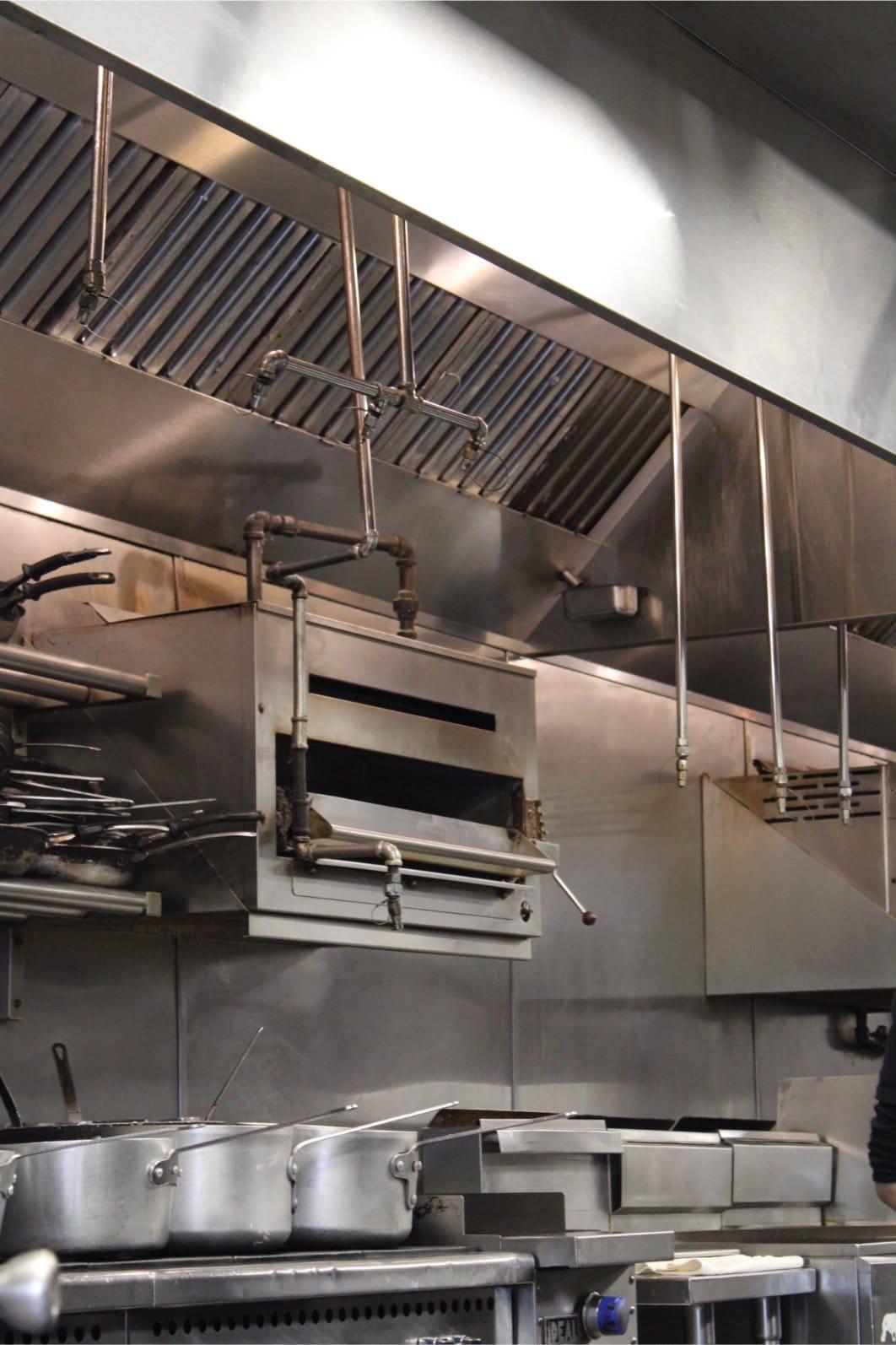
A grease fire in a Type I hood rarely stays in the hood.
It starts at the cooking surface. The exhaust system does exactly what it is built to do and pulls it up through the filters. And then it is in the duct — where, depending on the system, it may find more fuel: grease residue on the interior duct walls. From there it runs toward the roof, and the last component in its path is the exhaust fan.
Suppression systems are engineered to knock a fire down at the hood and the cook line. They are not engineered to reach thirty or forty feet up a vertical duct run.
So if the fire has moved past the hood, a crew has one way to reach it: go to the roof, take the fan off the curb, and open the duct from the top.
They will unbolt it, cut it, and break it apart to get access. They are not going to be careful about it, and they should not be. A rooftop fan runs a few thousand dollars. The building does not.
This is why an owner can end up buying new fans after a fire that never touched the dining room. The fans were not destroyed by flame. They were removed so the crew could put the fire out. That is correct procedure, and any Detroit engine company will tell you the same.
What the closure actually costs
The fans are the receipt everyone sees. They are rarely the biggest line.
- Every day dark is a day of zero revenue. For most Detroit independents that is four figures a day, minimum.
- Payroll. You pay your crew through the shutdown or you lose them to the spot down the street. Both cost.
- Product. Walk-in contents, prep, anything staged for the week.
- Fans plus rigging. Units, curb adapters, electrical reconnect, and a lift or crane if roof access is tight.
- Full system cleaning before you cook again. The duct has to be cleaned to bare metal and made whole.
- Suppression recharge. If the wet chemical system discharged, it needs recharge, retest, and certification.
- Fire marshal reinspection before you are cleared to reopen.
- Your insurance carrier’s full attention. This is the sleeper. After any grease fire, the adjuster asks for cleaning records. If those records are thin or missing, the conversation gets much harder.
What NFPA 96 requires
NFPA 96 — Standard for Ventilation Control and Fire Protection of Commercial Cooking Operations, published by the National Fire Protection Association — governs the whole exhaust path. Hood, filters, the full duct run, and the rooftop fan. Not just the stainless a customer can see.
Frequency is set by how you cook. The standard lays out four schedules: monthly for solid fuel (wood, charcoal), quarterly for high-volume operations, semiannual for moderate volume, annual for low volume. If you are running woks or charbroilers six days a week, an annual cleaning is not a schedule — it is an exposure.
“Clean” means to bare metal. NFPA 96 requires grease-laden surfaces be cleaned to bare metal. A service that wipes the hood, swaps filters, and hands you a sticker cleaned the part you look at, not the part that burns.
The responsibility is the owner’s. NFPA 96 puts inspection, maintenance, and cleanliness on the owner of the system unless it has been transferred in writing to a management company or tenant. Not the contractor. Not the landlord. That is the exact language an insurer will read back to you.
There is one more that operators miss: interior surfaces of the exhaust system have to be accessible for cleaning and inspection. If your duct has no access panels, nobody has cleaned the inside of it, and no schedule fixes that until the panels are cut in.
How it is enforced here
Michigan adopts the International Fire Code statewide through the Michigan Administrative Code, administered by the Bureau of Fire Services under LARA. The IFC references NFPA 96 by name for commercial cooking systems. That is the chain that makes a national standard enforceable in your kitchen.
In the city, the Detroit Fire Marshal Division handles fire prevention, inspections, code enforcement, plan review, and investigation, working from the Detroit Fire Prevention and Protection Ordinance, NFPA standards, and the Michigan Building Code. Detroit is currently on the 2021 Michigan Building Code, whose Section 904.13 requires every commercial cooking appliance that needs a Type I hood to be protected by an approved automatic fire-extinguishing system.
Practically: you are answering to the state-adopted fire code, the city ordinance, and — separately, and usually more aggressively — your insurance carrier. Carriers routinely require documented NFPA 96 compliance as a condition of coverage. They do not wait for a fire to ask for it.
What “IKECA-trained” is supposed to mean
IKECA is the International Kitchen Exhaust Cleaning Association — the trade body that trains and certifies technicians on how these systems get cleaned and inspected to standard. It is an ANSI-accredited standards developer, and its C10 cleaning and I10 inspection standards sit alongside NFPA 96 as the working methodology for this trade.
Here is the honest version of why it matters. This trade has almost no barrier to entry. Anybody can buy a pressure washer, print a certificate, and quote you half of what everyone else charges. The difference never shows up on the invoice. It shows up inside the duct, eighteen months later.
Three things you can verify on any service, from any company, ours included:
- Did the fan come off the curb? Blades and housing have to be cleaned. If the fan never moved, the top of your duct was never touched.
- Did they open the duct? Access panels opened, duct interior cleaned to bare metal along the full run. Vacuuming from the hood end does not reach it.
- Did you get documentation? Dated before-and-after photos of the duct interior and fan, a report noting any areas found inaccessible, and a certificate naming the standard and frequency. That is what a fire inspector wants and what an adjuster will demand.
Ask those three questions. If anybody hesitates on any of them, you have your answer. Here is how our process works.
Five minutes, today
- Pull a filter and look at the plenum behind it. Sticky film between services is normal. Black, tarry, or dripping is not.
- Go up on the roof. Pooled grease around the fan curb means the system has been overflowing for a while.
- Find your last service report. Does it name a frequency and a standard? Are there duct interior photos, or only hood photos?
- Count the months since your last full service. Does it match the schedule for the way you actually cook?
- Check your suppression tags. When was the last semiannual?
If any of those five make you uneasy, that is the point of this post.
Bottom line
Rikshaw Express got the good outcome. They are open, nobody got hurt, and the building is standing.
The bad outcome in a duct fire is a structure fire, and what separates the two is often just how much fuel was sitting in the duct when the flame arrived.
Nobody gets a warning. You get a schedule, a standard, and a crew that either does the whole system or does not.
We are IKECA-trained and we service Detroit and metro to NFPA 96 — whole system, fan off the curb, duct opened, cleaned to bare metal, documented with photos.
Not sure where your system stands? We will come out and show you the inside of your own duct before you commit to anything. No charge for the look.
Call 248-765-5027 or book an inspection.
Serving Royal Oak, Birmingham, Troy, Clawson, Ferndale, Berkley, Madison Heights, Southfield, Dearborn, Bloomfield Hills and Downriver.
Sources
- NFPA 96, Standard for Ventilation Control and Fire Protection of Commercial Cooking Operations — National Fire Protection Association
- ANSI/IKECA C10, I10 and M10 standards — ANSI Webstore
- IKECA Standards for Kitchen Exhaust Cleaning — ANSI
- International Kitchen Exhaust Cleaning Association — IKECA
- Fire Marshal Division — Detroit Fire Department
- Building Codes, Ordinances, and Acts — City of Detroit BSEED
- 2021 Michigan Building Code, Chapter 9, Section 904.13 — UpCodes
- Bureau of Fire Services — Michigan LARA