Access Panels: Proof the Duct Was Cleaned
From the kitchen floor, the hood canopy can look polished. The filters can be clean. A fresh service sticker can be on the hood. None of that proves the hidden grease duct above the ceiling was opened, inspected, cleaned, and photographed.
That is the problem with missing access panels.
An access panel gives the kitchen hood cleaning vendor a way to inspect and clean the duct. If a duct section cannot be viewed, that section cannot be directly verified as clean. It should be documented as inaccessible, not treated as complete.
This article explains what access panels do, how they affect hood cleaning documentation, and what to do when a duct section cannot be reached.
What Is An Access Panel?
An access panel, access door, duct access door, or cleanout is an opening on the grease duct itself. It lets a technician inspect and clean the inside of the duct. If you see the product category access doors & panels, confirm the part is meant for grease duct service, not general wall or ceiling access. A useful panel is removable, gasketed, and resealable.
It is not the same as a ceiling tile. A ceiling tile may let someone reach the outside of the duct, but it does not open the duct. It is also not the same as a fan hinge kit. A fan hinge kit helps open and service the rooftop exhaust fan, but it does not replace access along a concealed duct run.
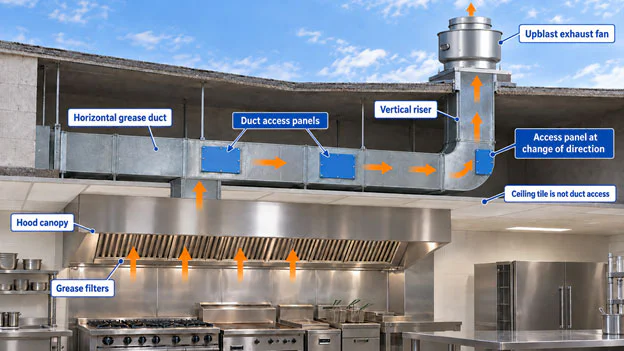
A commercial exhaust hood system includes the hood canopy, plenum, grease filters, ductwork, access panels, and rooftop exhaust fan. A duct can run horizontally above a ceiling, turn through an elbow, rise through a shaft, or connect to an exhaust fan on the roof. The parts the owner cannot see are often the parts that need access most.
| Item | What It Opens | What It Does Not Prove |
| Duct access panel | The inside of a duct section | That every other duct section was opened |
| Ceiling tile or hatch | The space around the duct | That the duct itself was opened |
| Fan hinge kit | The rooftop fan area | That hidden duct runs were accessed |
| Hood opening | The visible hood or plenum area | That remote duct sections were cleaned |
Why Missing Access Changes The Cleaning
Kitchen exhaust cleaning is a full-system service. It is not just a canopy wipe-down.
Grease can move past filters into the plenum, duct, turns, vertical risers, and fan housing. Some areas can be reached from the hood or rooftop fan. Long horizontal runs and changes of direction need their own access points.
A missing access panel does not always prove the entire system was skipped. It does mean the inaccessible section cannot be verified the same way an opened section can. If the vendor cannot open the duct, the vendor cannot directly inspect that duct section or produce inside-the-duct before-and-after photos.
That limitation belongs in the report. A vague invoice that says “hood cleaned” does not answer the access question.
What NFPA 96 And Local Codes Are Trying To Prevent
NFPA 96 is the main standard for ventilation control and fire protection in commercial cooking operations. It is the framework behind many local fire-code expectations for kitchen exhaust systems in Connecticut and New York State.
The enforceable details depend on the adopted code edition and the local Authority Having Jurisdiction, or AHJ. That means the local fire marshal or fire official decides what is acceptable for that location.
For restaurant owners in Connecticut and New York State, the practical point of NFPA 96 is simple. The system must be inspectable and cleanable. A duct that cannot be opened where access is needed creates a serviceability problem. Access is not just paperwork. It is how the hidden duct gets inspected and cleaned.
Connecticut, New York State, And NYC Jurisdiction Notes
Access-panel rules are enforced through adopted codes and the local AHJ, so location matters.
In Connecticut, local fire marshal expectations matter. Connecticut publishes fire safety and prevention code resources through the Office of the State Fire Marshal.
In New York State, current state code language matters. The 2025 Fire Code of New York State places commercial cooking equipment and systems in Section 606.
New York City has a separate FDNY framework for commercial cooking exhaust cleaning, including company approval, Certificates of Fitness, decals, and local administrative requirements.
Why Duct Access Spacing Uses Both 12 Feet And 20 Feet
Owners may hear both 12 feet and 20 feet cited as spacing between duct access openings. The numbers come from different access contexts, so they should not be treated as one universal rule.
| Context | What The Number Means | Owner Takeaway |
| NFPA 96 access concept | A 20-inch by 20-inch personnel opening is used where the duct can accommodate it. Where that size is not possible, smaller cleaning openings are placed closer together along horizontal runs. Openings are also needed at changes of direction. | Ask whether the duct section can actually be opened, reached, cleaned, and photographed. |
| New York State mechanical-code cleanout language | Mechanical-code cleanout spacing can allow wider spacing and also addresses distance from larger turns. | Ask which adopted code section the vendor, landlord, or inspector is applying. |
| FDNY training material | NYC training material describes 12-foot spacing as the default for horizontal runs, with 20 feet tied to the personnel-entry case. | Treat this as NYC-specific guidance unless the local AHJ says otherwise. |
A straight rectangular duct, a round duct, and a duct with multiple turns can have different access requirements. If a vendor, inspector, or landlord quotes 12 feet or 20 feet, ask which rule and code edition they mean. The better owner question is still this: can each hidden duct section be opened, cleaned, photographed, and documented?
What A Good Hood Cleaning Report Should Show
A useful report tells the owner what was opened, what was cleaned, and what could not be reached.
At minimum, look for service date, areas cleaned, areas not cleaned, access-panel locations, and before-and-after photos from inside opened duct sections. The report should also identify any missing, blocked, sealed, painted-shut, damaged, leaking, or poorly gasketed access points.
| Report Item | Why It Matters |
| Access-panel location | Shows which duct section was opened |
| Before photo | Shows the starting condition inside the duct |
| After photo | Shows what was cleaned |
| Inaccessible note | Keeps an unverified section from being treated as complete |
| Corrective-action note | Gives the owner a next step |
| Follow-up cleaning note | Confirms that access installation is not the final step |
A report with only canopy photos leaves a documentation gap. The hood may be clean, but the report has not shown what happened inside the duct.
Red Flags After A Claimed Cleaning
Review the last report before the next inspection, lease review, or insurance request. Look for these issues:
- The report has only canopy or filter photos.
- No duct-interior photos are included.
- No access-panel locations are listed.
- The report mentions an inaccessible duct section but does not identify where it is or why it could not be reached.
- Existing access doors look untouched after service.
- Panels are painted shut, blocked, sealed, hidden above a ceiling, damaged, or leaking.
- The rooftop exhaust fan was opened, but the horizontal duct below the roof deck was not documented.
- The invoice says “hood cleaned” with no system detail.
A weak report is not proof of bad work by itself. It is proof that the owner does not have enough documentation. If the duct was opened, cleaned, and photographed, the report should make that clear.
What To Do If Access Panels Are Missing
Start with the last report. Find every note about inaccessible duct sections. If the report does not mention duct access at all, ask the vendor what was opened and photographed.
Then ask whether any panel was missing, blocked, sealed, painted shut, damaged, or leaking. Get inaccessible areas in writing. A verbal explanation will not help much months later when a fire marshal, landlord, or insurer asks what was done.
If the duct runs through a ceiling, behind drywall, inside an insulated chase, through a shaft, or through shared building space, coordinate with the landlord, property manager, or qualified trade. Access may involve building conditions outside the cleaning vendor’s control. If new duct access is being added, match the grease duct and do not use a standard HVAC access door. Access Panels for grease-laden systems must be UL listed for that specific use and must be installed according to manufacturer instructions.
Installing access is not the same as cleaning. After access is created or restored, the newly reachable section still needs follow-up cleaning and documentation. Keep the deficiency note, access work record, and follow-up cleaning report together.
Before You Treat The Cleaning As Complete
The access-panel issue comes down to proof. A complete record should show which duct sections were opened, what the inside looked like before and after cleaning, and which sections were not reachable.
If the report cannot show that, do not treat the hidden duct as verified. Document the gap, restore access where needed, and schedule follow-up cleaning after that section can be opened.
For Connecticut and New York State operators, the practical standard is not just a clean hood. It is a record that shows what was accessed, what was cleaned, and what still needs attention.
FAQ
What is an access panel?
An access panel is an opening on the grease duct that allows inspection and cleaning of the duct interior. It is also called an access door or cleanout. It is not the same as a ceiling tile or general ceiling hatch.
Is a fan hinge kit the same as a duct access panel?
No. A fan hinge kit helps open and service the rooftop exhaust fan. It does not provide access to concealed duct sections below or away from the fan.
If my duct has no access panels, did the vendor clean it?
The vendor may have cleaned what could be reached from the hood or fan. Any section that could not be opened should be documented as inaccessible, not treated as verified clean.
Why do some sources say 12 feet and others say 20 feet?
Different code contexts, duct conditions, and access methods can use different spacing language. Ask which rule, code edition, and duct condition applies to your system.
What should my hood cleaning report include?
The report should identify opened access panels, cleaned areas, inaccessible areas, and before-and-after photos from inside the duct where access exists. It should also note missing, blocked, damaged, sealed, or leaking panels.
Do older restaurants need access-panel retrofits?
Older systems often need corrective repairs to improve access if hidden duct sections cannot be inspected or cleaned. The answer depends on the adopted code, local AHJ, building conditions, and lease responsibility.