"*" indicates required fields
Exhaust, Hood and Full Ventilation System Cleaning
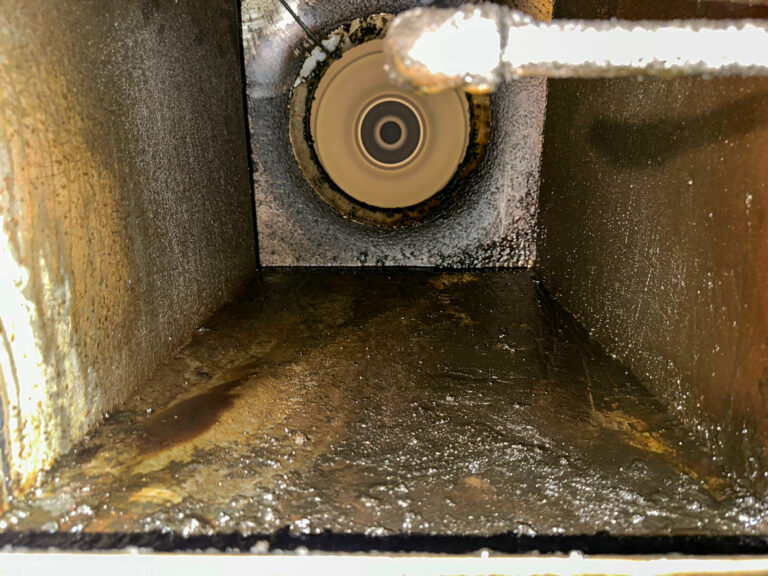
Most hood cleaning quotes cover the part of the system you can see standing on the kitchen floor. The grease that starts fires is further up, in the plenum behind the grease filters, along the horizontal duct runs above the ceiling, and inside the fan housing on the roof. We clean the full path to bare metal wherever the system allows it, photograph every section before and after, and tell you plainly where access panels are missing and a run cannot be reached. That last part matters more than it sounds, because NFPA 96 requires any area that could not be cleaned to be documented, and a report that quietly leaves it out is the one that fails you during a claim.
What NFPA 96 Requires of Your Kitchen
The code sets how often your system has to be inspected based on how hard the kitchen runs, and the full set of intervals is laid out in our guide to the NFPA 96 standards. Solid fuel cooking is inspected monthly, high-volume operations running twelve to twenty-four hours a day quarterly, moderate-volume kitchens running six to twelve hours semiannually, and low-volume operations under six hours annually. Cleaning follows whenever that inspection finds grease, which in a working kitchen usually means the inspection date and the cleaning date are the same. Your local fire authority can require more than the code minimum, and some jurisdictions in Northeast Ohio do.
Every visit produces a certificate for your premises and a label in the kitchen showing the date, our company name, and any areas we could not clean, which are the two things an inspector looks for. The photographs go further than the code asks, and they are what settles a disagreement with a fire marshal or an adjuster who wasn’t on the roof with us. Most commercial property policies condition kitchen fire coverage on documented NFPA 96 compliance, and those records are the first thing a carrier requests when a claim comes in.
Every Technician Is on Our Payroll
The people who work on your system are Kitchen Guard employees, not subcontractors called in that morning. It is the difference between a crew that answers to us and a crew that answers to nobody you can reach, and it shows up in the parts of the job you never see: whether the rooftop fan actually came apart, whether the photographs match the building, whether the same people come back next quarter already knowing where your access panels are. When something goes wrong on a property we serviced, there is no third party standing between you and the person accountable for it.
Scheduling and Coverage Across Northeast Ohio
We work around your service hours rather than through them. For most restaurants that means overnight or early morning, for venues between events, and for schools and corporate cafeterias during scheduled closures. You get the service window before the job is booked. If a cleaning turns up a failing fan, a worn belt or a duct run with no way in, we handle those repairs as well, usually while the system is already open.
Kitchen Guard of Northeast Ohio serves restaurants, corporate cafeterias, hospitals and assisted living kitchens, schools, hotels and sports venues from Cleveland and Akron through Canton and Youngstown. If you are responsible for more than one location, we will map the full exhaust run at each and put them on a single schedule, so compliance stops being something you chase building by building.
Hood Cleaning in Northeast Ohio, Answered
The questions we hear most from owners and facility managers across Cleveland, Akron, Canton and Youngstown, on how often the code requires service, what a cleaning actually covers, and who is responsible for which part of the system.
The code sets the inspection interval by how hard the kitchen runs. Solid fuel cooking is inspected monthly, high-volume operations running twelve to twenty-four hours a day quarterly, moderate-volume kitchens running six to twelve hours semiannually, and low-volume operations under six hours annually. Cleaning is required whenever that inspection finds grease accumulation, which for most working kitchens makes the inspection interval the cleaning interval in practice. Your local fire authority can require more frequent service.
Hood and filters, the plenum behind them, the horizontal duct runs above the ceiling, the vertical riser, and the fan housing on the roof, cleaned to bare metal wherever the system allows. Where access panels don’t exist and a run genuinely can’t be reached, we document that area as not cleaned rather than skip past it, which is what the code requires and what protects you later.
No. Every technician on your system is a Kitchen Guard employee on our payroll. Much of this industry runs on subcontracted crews, which is why the quality of a cleaning can change from one visit to the next and why nobody can tell you who was actually on the roof. Our people come back to the same buildings, and we are accountable for the work without a third party in between.
A certificate showing the date of service, kept on your premises, and a label in the kitchen listing the date, our company name, and any areas that could not be cleaned. We also photograph every section of the system before and after and send the report the same day. Photos aren’t required by the code, but they’re what settles a disagreement with an inspector or an adjuster.
The lease decides it, and it’s worth reading before an inspection rather than after one. Building owners commonly retain the ductwork and rooftop fan as building infrastructure while the tenant handles the hood and filters, which leaves the middle of the system as the part nobody scheduled. When we survey a property we map the full run and tell you where the split falls.
No. We schedule around your service hours, overnight or early morning for restaurants, between events at venues, and during closures for schools and cafeterias, and give you the window before the job is booked.
Frequently both. Restricted airflow shows up first as a hot kitchen and a dining room that smells like the fryer, and the cause is usually loaded filters or a grease-choked duct, though a worn belt or a failing upblast fan produces the same symptoms. We diagnose it during cleaning while the system is already open, which is when a repair costs the least and interrupts the least.