
"*" indicates required fields
Kitchen Exhaust Cleaning for Athens and Athens‑Clarke County
Athens runs on food. The blocks around Broad and Clayton turn covers from lunch service through last call, campus dining rooms feed a city’s worth of students every day, and a home football weekend pushes a kitchen to volumes it will not see again until the fall. All of that cooking ends up in the same place — a grease film building inside the hood, the duct behind the wall, and the fan sitting on your roof. NFPA 96 sets how often that system has to be cleaned, and Kitchen Guard of Northeast Atlanta‑Athens cleans the entire path rather than the part you can see from the cook line. It matters: in U.S. Fire Administration data covering 2011 through 2013, cooking accounted for roughly 64 percent of restaurant fires.
What a Full Cleaning Covers
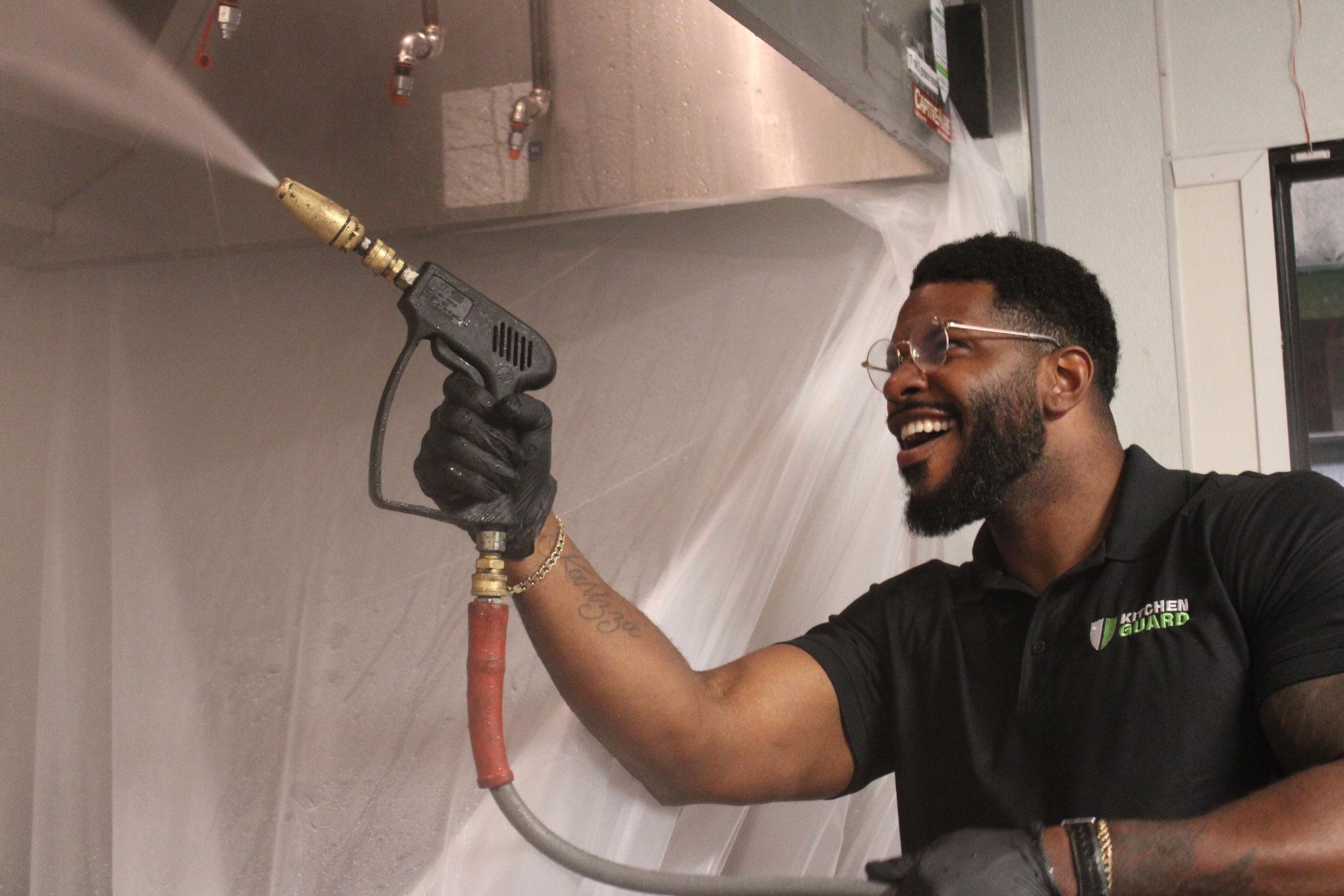
A hood cleaning that stops at the canopy leaves most of the fire load in place. We clean the canopy and the plenum behind the baffles, handle the filters, work every accessible run of horizontal and vertical duct, and open the rooftop fan so the housing, blades, and hinge get scraped instead of wiped around. Where a duct run has no access panel, you hear about it before we start rather than getting billed for a section nobody could reach. The step‑by‑step process is laid out on our hood cleaning page.
How Often Athens Kitchens Need Service
The interval follows the cooking, not the calendar. Solid‑fuel cooking over wood or charcoal calls for monthly inspection and cleaning. High‑volume operations — charbroiling, wok cooking, and kitchens running close to around the clock, which describes a good share of downtown Athens — fall on a quarterly cycle. Moderate‑volume kitchens are semiannual, and low‑volume settings such as church halls, seasonal operations, and senior centers are annual. If you are not sure which line you sit on, we will look at your equipment and your cook volume and tell you.
Documentation That Holds Up at Inspection
The Athens‑Clarke County Fire Marshal’s Office inspects commercial kitchens against NFPA 96, the standard Georgia enforces through the Safety Fire Division of the state insurance commissioner’s office, and after any kitchen fire an insurance adjuster asks the same question: when was this system last cleaned, and by whom. Every visit is documented with the date and the scope of work performed, so the answer is on file rather than somewhere in a manager’s memory.
The Rest of the System
Cleaning turns up problems worth knowing about — a fan belt on its last month, a missing access panel, a hinge kit that never got installed, an exhaust fan that is not moving the air it should. We handle that work directly through exhaust system repairs, and for the grease that ends up outside the building, on the dumpster pad, the drive‑through lane, or the sidewalk out front, there is commercial pressure washing.
Campus, Hospital and Stadium Kitchens in Athens
Athens-Clarke County food service goes well beyond the restaurant line. The University of Georgia runs campus dining halls, retail food courts and concession kitchens at Sanford Stadium, and the county hospitals, hotels, K-12 schools and senior living communities all operate commercial hoods under the same NFPA 96 requirements. High-volume cooking on a semester or game-day schedule builds grease far faster than a light-use kitchen, and NFPA 96 sets inspection frequency by cooking volume rather than by the size of the building.
Downtown Athens adds its own constraints. Kitchens packed into older buildings along Broad Street and the blocks around it often share alley access, tight rooflines and long horizontal duct runs. Those conditions affect how a system has to be cleaned, how much of the duct can be reached from the roof, and when the work can realistically be scheduled, which is why an on-site look tells you more than a phone estimate.
To get on the schedule in Athens, call 678‑707‑5651 or send us the details through the contact page.
Hood Cleaning in Athens — Common Questions
What Athens operators ask before booking their first cleaning.
It depends on what you cook and how much of it. Wood‑ and charcoal‑fired kitchens are on a monthly interval under NFPA 96. High‑volume operations — heavy charbroiling, wok cooking, and kitchens running near around the clock, which covers a lot of downtown Athens and the late‑night trade — are quarterly. Moderate‑volume kitchens are semiannual and low‑volume settings are annual. We will assess your line and tell you where you fall instead of putting every account on the same cycle.
Yes. The fan is part of the exhaust system, not an extra. We open the housing, clean the blades and the interior, and check that the hinge and mounting are sound while we are up there. A cleaning that leaves the fan alone leaves grease sitting at the top of the duct, which is exactly where it does the most damage in a fire.
You get a record of the visit showing the date and the scope of the work performed on your system. That is what a fire official is looking for during an inspection, and it is the first thing an insurance carrier asks for after a loss.
We do. Along with Athens and Athens‑Clarke County, we serve Watkinsville, Winder, and the Northeast Atlanta corridor — Buford, Lawrenceville, Duluth, and Norcross — across Gwinnett, Barrow, and Athens‑Clarke counties.
