Baffle vs Mesh Filters: What NFPA 96 Allows
Mesh filters are not interchangeable replacements for baffle filters in a commercial kitchen hood. NFPA 96, the standard for ventilation control and fire safety in commercial cooking operations, prohibits mesh filters except in two specific evaluated or listed arrangements.
For Connecticut and New York restaurant owners, replacing a primary grease filter means finding a listed product that matches the hood’s requirements. It does not mean choosing between baffle and mesh construction by size, appearance, or price. Mesh in specialized equipment needs documentation of its role in that evaluated arrangement.
This article explains how the filters work, where NFPA 96 permits mesh, and what Connecticut and New York operators should check before replacing or maintaining hood filters.
Baffle Filter Vs Mesh Filter: Mechanisms And Restrictions
Baffle grease filters use interlocking baffles to change the direction of exhaust air. Grease droplets collect on the metal surfaces, and the filter’s drainage arrangement directs collected grease toward the hood’s collection trough.
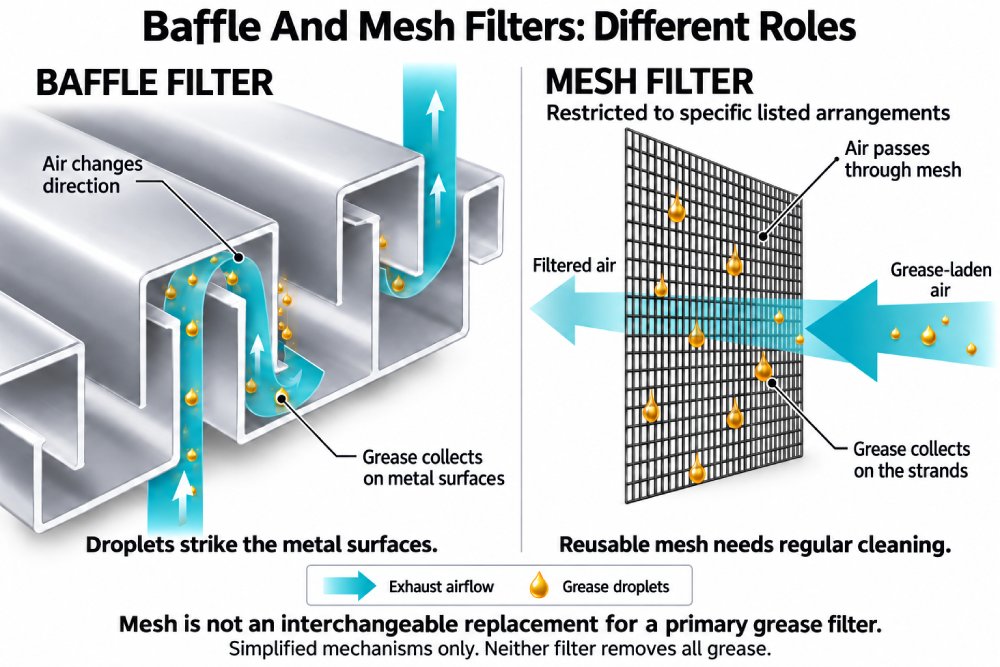
Mesh filters use intersecting strands or layers of screen to intercept material in the airstream. That mechanism does not make mesh acceptable as a replacement primary grease filter. Where reusable mesh is part of a permitted evaluated arrangement, grease collects on the strands and within the layers. It needs regular cleaning according to the manufacturer’s instructions to maintain airflow and grease filtration performance.
The diagrams illustrate how each filter captures grease. They do not imply that the filters are interchangeable or that either type removes all grease from the exhaust air.
| Filter Characteristic | Baffle Construction | Mesh Construction |
| Visible design | Formed metal channels | Intersecting strands or layered screen |
| General separation method | Air changes direction; grease collects on surfaces | Material is intercepted across the media |
| Commercial hood use | Primary grease removal with the required listing and hood compatibility | Restricted to specific evaluated/listed arrangements; not an interchangeable primary-filter replacement |
For a replacement primary filter, ask the supplier for model-specific listing information and check it against your hood manufacturer’s requirements.
NFPA 96 Requirements For Baffle And Mesh Grease Filters
NFPA 96’s starting rule is that mesh filters shall not be used. The exceptions apply only where the mesh is evaluated as an integral part of a listed exhaust hood or listed in conjunction with a primary filter under UL 1046, or CAN/ULC-S649 for Canada.
These are specific evaluated arrangements. They do not permit an owner to substitute a generic mesh screen for a baffle filter or add mesh behind an existing filter without the required evaluation.
For example, Halton identifies a secondary mesh filter for its Capture Ray UV hoods that sits behind the primary KSA cyclonic filter. This is a manufacturer-specified secondary component, not an alternative primary filter. Its presence in that equipment does not authorize the same screen to be used in another hood.
NFPA 96 also requires listed grease filters or other listed grease-removal devices for commercial cooking. Removable devices that are not integral to a specific listed hood must be listed to UL 1046 and designated on the filter. “Listed” refers to identified equipment evaluated for a relevant standard or specified purpose. A material description alone does not provide that evidence.
Filter listings and hood listings also have different scopes. UL 1046 addresses grease filters, including flame projection after grease loading and drainage. Certain integral or manufacturer-specific devices are evaluated with the system instead. A system evaluation does not automatically override a separate local operating requirement.
These distinctions concern commercial grease removal. Residential products, heat-and-steam hoods, and specialized listed systems cannot be treated as interchangeable examples.
Commercial Kitchen Grease Filter Requirements In Connecticut And New York
The standard explains the filter requirements, but your location determines the enforceable code framework.
| Location | Applicable Filter Requirement |
| Connecticut | The 2022 State Fire Prevention Code references NFPA 96 for commercial cooking operation and maintenance. |
| New York State outside NYC | The 2025 Fire Code requires UL 1046-listed and labeled grease filters in place while equipment under a kitchen grease hood is used. |
| New York City | The NYC Fire Code requires grease filters of a Certificate of Approval type. Approved filters must be properly positioned whenever cooking appliances are in use. |
In New York State, a listed hood’s installation exception does not expressly waive the separate operating clause above. If your equipment uses an integral extractor or another specialized arrangement, obtain the manufacturer’s documentation and the local fire official’s determination before assuming an exemption.
Before You Buy A Replacement Filter
Start with the hood’s identity, rather than the supplier’s size chart.
- Identify the hood and existing filter. Photograph the hood’s data plate and the filter’s manufacturer, model, and certification markings. Collect the installation manual and any filter information supplied with the equipment.
- Verify the product’s evaluation. Ask the supplier for documentation tied to the exact model. Check it through the relevant certification body or have the manufacturer confirm it. For an ETL-listed product, the Intertek directory provides a model-search route.
- Confirm compatibility with the hood. Check the replacement against the hood manufacturer’s instructions and the permitted configuration. Dimensions, intended airflow, mounting orientation, and grease drainage all matter.
- Check the installed fit and keep the records. Filters should seat correctly without gaps or improvised changes to the rack. Retain the product data, listing information, purchase details, and any written clarification from the manufacturer. If the proposed replacement requires alterations, resolve that before installation.
Ask a qualified vendor to help identify missing information. For a disputed code interpretation or an unusual assembly, involve the Authority Having Jurisdiction, or AHJ, such as the local fire marshal or fire official.
Kitchen Hood Filters: When To Clean Or Replace Them
Grease buildup and physical damage require different responses. A suitable, serviceable filter needs appropriate cleaning. A distorted frame or separated internal component needs assessment for repair or replacement under the manufacturer’s instructions.
For example, a washed metal filter can still leave an open gap because its frame is twisted. Washing removes residue; it does not restore the frame’s shape or make the filter seat correctly.
Check for damage that affects fit, drainage, or the filter’s internal arrangement. Do not force a bent unit into the track or assume a heavily contaminated filter must be discarded if the manufacturer permits effective cleaning.
Follow the manufacturer’s instructions for the cleaning method and choice of degreaser. There is no single chemical, dishwasher procedure, or replacement age that applies to every filter. Set routine care around the cooking operation and applicable local requirements.
For kitchens that want routine filter care handled by a vendor, Kitchen Guard’s filter exchange program offers scheduled, after-hours filter swaps in Fairfield and Westchester. This reduces the filter-cleaning workload for kitchen staff and keeps the exchange work outside cooking service.
What To Do If Your Kitchen Hood Has Mesh Filters
If mesh is installed where the primary grease filter should be, ask the hood manufacturer or a qualified vendor to identify the arrangement promptly. Request documentation showing whether a listed exception applies to that exact hood and filter configuration. A mesh screen’s dimensions or a supplier’s general description cannot establish the exception.
If the installation does not meet the applicable requirements, arrange suitable listed replacements matched to the hood manufacturer’s instructions. Consult the AHJ about corrective action and any unresolved operating conditions. Washing an unsuitable screen does not make it an acceptable primary filter.
Do not remove required filters and continue cooking. New York State’s operational requirements apply to existing operations as well as new ones. For an older Connecticut installation, ask the local fire marshal how the applicable requirements and retroactivity provisions affect the equipment.
FAQs
Can An ETL-Listed Filter Meet UL 1046?
Yes. UL 1046 is a test standard; ETL is a certification mark. A filter can be ETL-listed to that standard. Check the exact model and certification record, because an ETL mark on a different type of product does not establish a UL 1046 evaluation or compatibility with your hood.
Can I Mix Different Filter Models In One Hood?
Do not assume that matching dimensions permit a mixed filter bank. Confirm that the combination is supported by the hood manufacturer’s instructions and the applicable listing. Differences in airflow resistance (pressure drop) or drainage arrangements need assessment before substitution.
Can I Choose A Commercial Hood Filter By Its Metal?
Commercial hoods use listed baffle filters made from aluminum or stainless steel. Aluminum mesh remains subject to NFPA 96’s mesh restriction. The metal alone does not determine suitability. Check the exact model’s listing, hood compatibility, and material-specific cleaning instructions before selecting a replacement.
How Long Should A Commercial Grease Filter Last?
Filter durability depends on its construction, handling, cleaning, and the demands of the kitchen, including high-heat cooking. Follow the manufacturer’s inspection and replacement guidance rather than assuming a fixed lifespan. Damage that affects fit, drainage, or internal components requires assessment even if the filter is relatively new.
Can A Finer Mesh Screen Replace A Commercial Hood’s Primary Filter?
No. Fine mesh is not an interchangeable replacement for the hood’s required primary grease filter. Smaller openings do not create an exception to NFPA 96’s mesh restriction. Mesh can be used only within the specified evaluated/listed arrangements, with documentation for the actual system.
Does A Grease Filter Eliminate Kitchen Fires?
No filter eliminates every fire risk. Because filters are the first line of defense for minimizing the amount of grease in the exhaust system, they can be loaded with grease, especially if there is not a regular deep cleaning cycle in place for them (see our Filter Exchange Service page), and because they are loaded with grease, they can be the connecting point between a flare-up on the cooktop and a fully involved fire in the ducting. This is why it is important to have proper filters that don’t hold the grease as a mesh filter does, but redirect it like a baffle filter.