Grease Buildup in Restaurant Hoods: Health Risks & Legal Liability
Grease dripping from a hood, smoke rolling past the filters, or a greasy rooftop fan tells an operator one thing: the kitchen exhaust system needs attention beyond a surface wipe-down. The visible grease is the part staff can see. The larger concern is the grease that has moved into filters, the plenum, ductwork, access areas, and the rooftop fan.
That buildup matters in several ways. Visible grease can create sanitation and health inspection problems. Hidden grease can create fire exposure. Poor records can leave the operator without a clear answer when a fire marshal, insurer, landlord, or health inspector asks what was cleaned and what remains unresolved.
This article focuses on exhaust-system grease in commercial kitchen hoods. Sewer fats, oils, and grease (FOG), grease traps, interceptors, and wastewater compliance are not covered here. They are separate issues, and separate rules apply.
How Grease Builds Up In A Restaurant Exhaust System
Commercial cooking produces grease-laden vapor in high volume. Sitting directly above the cooking area in a restaurant kitchen, the hood captures most of these vapors, but it is not the only part of the commercial exhaust system. The full grease-bearing path includes:
- Hood canopy
- Baffle filters
- Grease cups or troughs
- Plenum
- Horizontal or vertical ductwork
- Duct access areas
- Kitchen exhaust fan
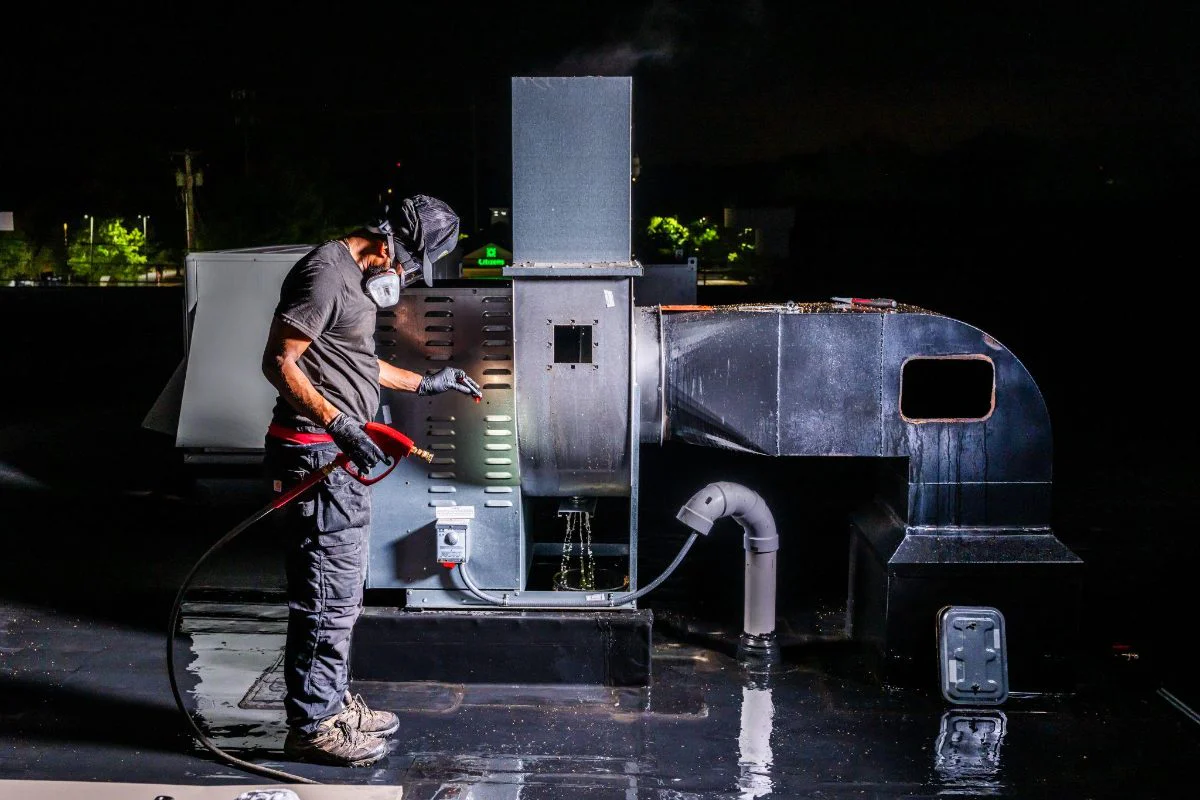
All of these components need periodic inspection and cleaning. Grease can collect on fan blades, inside the fan housing, and around rooftop grease containment areas.
Baffle filters remove some of the grease before air moves deeper into the system, but they do not capture everything. Remaining vapor moves into the plenum, ductwork, and fan, where it cools and leaves deposits on interior surfaces.
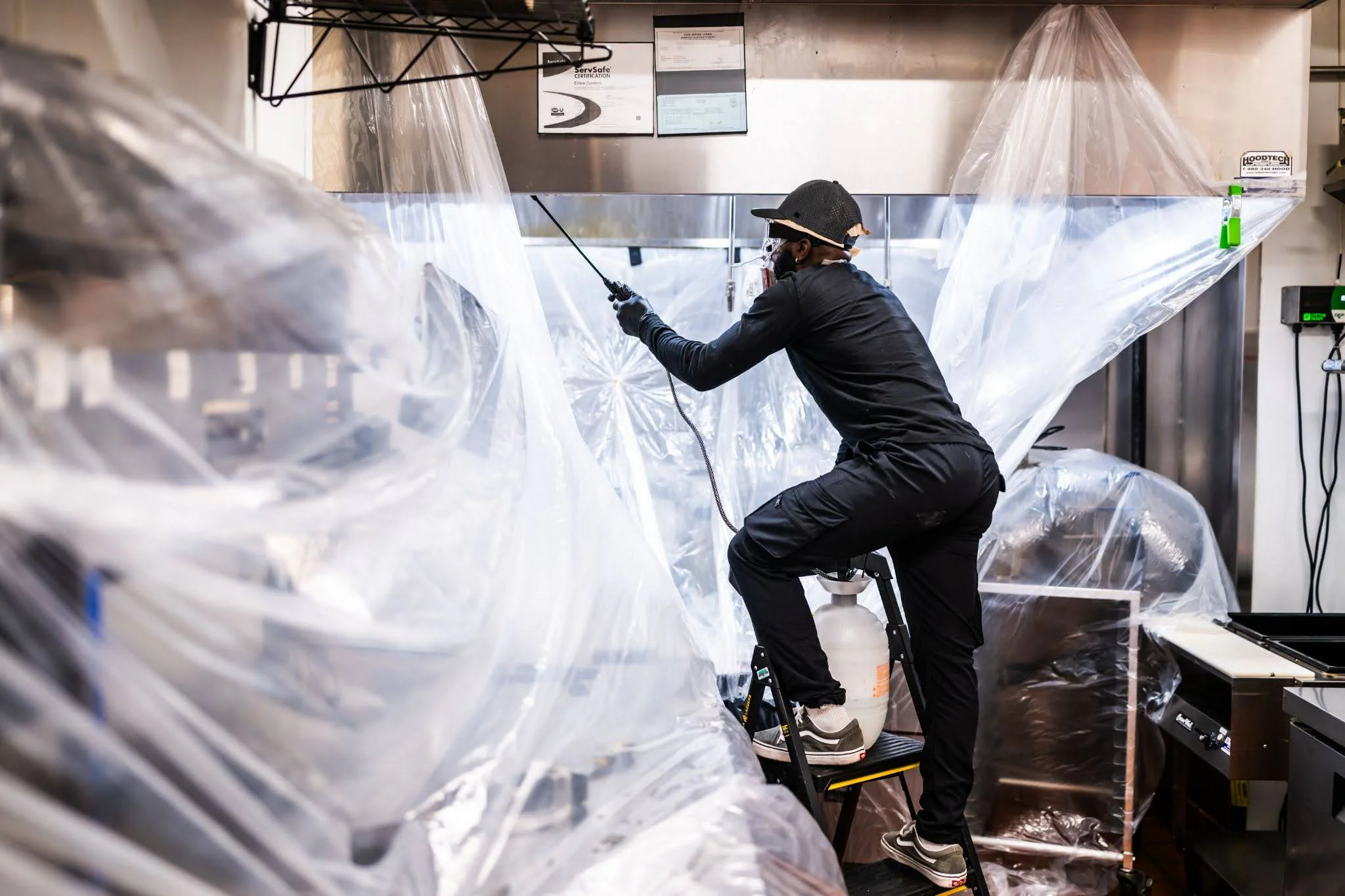
That is why a clean-looking hood face does not prove a clean system. A staff wipe-down addresses visible surfaces, but full vent hood cleaning is necessary to clean the entire exhaust path, including ductwork, access areas, and rooftop fan components that staff cannot inspect from the cooking line.
Why Visible Grease Is Only The First Warning Sign
Visible grease, smoke spillage, odors, and rooftop staining point to different parts of the exhaust system that may need attention.
| What You See | What It Means | What To Check |
|---|---|---|
| Grease dripping from the hood | Filters, cups, or plenum areas are overloaded | Filters, grease cups, plenum, duct access |
| Smoke escaping into the kitchen | Capture or airflow is weak | Filters, duct restriction, fan performance |
| Persistent cooking odors | Exhaust performance is not keeping up with the kitchen | Hood capture, ducts, rooftop fan |
| Grease around the rooftop fan | Grease has traveled through the system | Fan housing, fan blades, roof area |
| Sticker with no report | The scope of cleaning is unclear | Written report, photos, deficiencies |
A hood can look acceptable during service while the ductwork or rooftop fan still carries grease. That is the gap that creates inspection problems. It also explains why documentation matters as much as the cleaning date.
Is Hood Grease A Health Risk?
Visible hood grease becomes a health concern when it affects sanitation, ventilation, or working conditions.
Grease dripping from a hood can create contamination concerns if it reaches food, prep surfaces, kitchen equipment, clean wares, or areas above active cooking. Grease-coated filters and stainless steel hood surfaces can draw attention during a health inspection because they point to poor maintenance of non-food-contact surfaces.
Poor capture creates a second problem. Smoke, heat, odors, and cooking emissions stay in the kitchen instead of moving through the exhaust system. Staff feel the result as heat, irritation, discomfort, and poor working conditions during service.
Health inspectors focus on visible grease, sanitation, dripping, ventilation, and cleanliness. Their review does not fully answer the fire-safety question inside ducts and rooftop fans. A kitchen can address the visible sanitation issue and still need a deeper exhaust-system review.
Why Grease Buildup Becomes A Fire Risk
The fire risk comes from fuel inside the exhaust path. Grease-laden vapor leaves deposits in the hood, plenum, ductwork, and fan. Those deposits create combustible material beyond the cooking surface and increase the risk of grease fires.
If a cooking-line fire reaches the hood or plenum, grease in the exhaust path gives the fire fuel beyond the cooking surface. Suppression nozzles are not designed to clean or protect the full duct run and rooftop fan.
A flare-up can move from the cooking line into the hood, then into grease deposits in the plenum. From there, it can follow buildup through the ductwork toward the rooftop fan. By the time fire reaches the duct or fan housing, the risk is no longer limited to what staff can see above the cooking line.
Duct grease is harder to see. Rooftop fan grease is farther from daily kitchen attention. Older duct runs can make duct cleaning harder unless access is properly documented.
Fire suppression service does not replace exhaust cleaning. The suppression system is designed for a cooking-surface emergency. It does not scrape grease out of duct runs, clean fan blades, clear fan housings, or correct rooftop grease conditions.
This is why hood cleaning is important for reducing fire risk through fuel-load reduction. Suppression helps during an event. Cleaning reduces the fuel that allows a hood or duct fire to spread.
Hood Grease Buildup: Legal Liability
Legal exposure starts with a practical question: if a fire marshal, insurer, landlord, or investigator asks what was cleaned, when, by whom, and what was left unresolved, can the operator answer from the file?
Hiring a hood cleaning service transfers the cleaning work. It does not remove the operator’s responsibility to keep the system maintained, documented, accessible, and ready for inspection. The cleaning record has to show more than a visit date.
Documentation matters because different people ask different questions. A fire marshal can ask whether the full system was cleaned and tagged. An insurer can ask whether maintenance was current. A landlord can ask whether the tenant met lease obligations. A fire investigator can review whether known deficiencies were ignored.
Deficiency notes deserve serious attention. If a vendor report identifies inaccessible ducts, missed areas, missing access panels, rooftop grease, or mechanical problems, those notes become action items. Leaving the same deficiency unresolved across service cycles gives the operator a weaker record after an inspection, insurance review, or incident.
In a post-fire review, documented inaction can also be characterized as gross negligence. A gross negligence finding can carry serious insurance and civil liability implications. Outcomes depend on the facts, the policy, the lease, the jurisdiction, and the reviewer.
Rooftop grease creates another property concern. Grease around the fan can stain or damage roof materials and lead to landlord disputes even without a fire. Operators should confirm that rooftop fan access, fan cleaning, and grease containment are part of the vendor’s scope and appear in the service report.
Health Inspector, Fire Marshal, Insurer, And Landlord: Who Looks For What?
Each reviewer looks at the hood system through a different lens. That is why passing one review does not answer every compliance question.
| Reviewer | Main Concern | What They May Ask For |
|---|---|---|
| Health inspector | Visible grease, dripping, sanitation, ventilation | Clean visible areas and proof of maintenance |
| Fire marshal or Authority Having Jurisdiction (AHJ) | Fire load, full-system condition, access, records | Cleaning report, service tag, photos, deficiency notes |
| Insurance carrier | Maintenance history and risk control | Reports, photos, service history, repair follow-up |
| Landlord or property manager | Building protection and lease compliance | Current service proof, correction plan, records |
In Connecticut, local fire marshals are the primary enforcement point. In New York State, fire-code records and a current service tag are a specific on-site requirement. Westchester operators can also face health inspection scrutiny around visible grease, ventilation, and non-food-contact surface conditions.
The Role Of NFPA 96 In Connecticut And New York
Connecticut and New York operators should treat NFPA 96 from the National Fire Protection Association as the core commercial cooking ventilation and fire-protection standard, then confirm how the local AHJ applies it.
In Connecticut, commercial cooking operation, inspection, and maintenance connect back to NFPA 96 through the fire-code framework. Local fire marshals can look beyond the visible hood and ask about the full kitchen hood cleaning record. They can also require more frequent cleaning when observed grease buildup shows that the current interval is not controlling the hazard. Health inspectors can flag visible grease, sanitation, dripping, and ventilation conditions.
In New York State outside New York City, fire-code materials require commercial kitchen hood maintenance, records, and service tags. Operators should keep service records on-site or readily available, make sure the tag is current, and confirm local expectations with the AHJ. Westchester operators can also face county health inspection scrutiny around non-food-contact surfaces, visible grease, and ventilation performance.
New York City adds a stricter FDNY layer, including FDNY-approved servicing vendors, technician credential requirements, and FDNY service decals. Those requirements are specific to New York City and should not be treated as the rule for all New York State restaurants.
Older Buildings And Inaccessible Ductwork Are Not A Free Pass
Fairfield and Westchester restaurants often operate in older buildings, mixed-use properties, and spaces inherited from prior tenants. The duct run can disappear into a wall, ceiling, chase, or tight building cavity. That creates a common misunderstanding: if the duct is hard to reach, the operator assumes it is exempt.
Inaccessibility is not a permanent exemption. If a section cannot be inspected or cleaned, the report should say so. The vendor should identify what was inaccessible, why it could not be reached, and what correction is needed.
The right response is a documented plan. That can include access corrections, repair recommendations, follow-up service, or further review by the appropriate contractor or AHJ. The owner should keep records showing what was corrected and what still needs attention.
This matters because a report that identifies inaccessible areas creates a written record. If the same access issue appears again and again with no follow-up, the operator has a harder time showing reasonable action.
How Often Should Grease Be Cleaned From Restaurant Hoods?
There is no single cleaning interval that fits every restaurant. The schedule depends on cooking volume, fuel type, menu, grease load, equipment, operating hours, observed buildup, and local AHJ expectations.
Operators in Connecticut and New York should confirm the baseline schedule with the local AHJ and use observed grease buildup to judge whether the current interval is working. A vendor who inspects the full system can tell whether the current interval is too long for the kitchen’s actual grease load.
| Operation Type | Cleaning Consideration |
|---|---|
| High-volume or heavy grease cooking | Needs closer inspection and more frequent cleaning |
| Moderate-volume cooking | Schedule should match observed grease and code guidance |
| Low-volume or seasonal kitchens | Records still matter even when intervals are longer |
| Solid fuel, smokers, wood-fired, or charcoal | Needs closer attention and AHJ confirmation |
The schedule should change when the kitchen changes. A new charbroiler, longer hours, breakfast service, higher volume, or wood-fired cooking can make an old interval inadequate.
What A Proper Hood Cleaning Report Should Show
A sticker is useful as a visible service marker. An invoice proves that a service was billed. Neither one proves that the ducts, access areas, fan blades, fan housing, and rooftop components were cleaned.
A proper hood cleaning report should show the date of service, vendor identity, areas cleaned, before-and-after photos, inaccessible areas, deficiencies, repair recommendations, and the next recommended service timing.
| Proof Item | What It Shows | Why It Matters |
|---|---|---|
| Service tag or sticker | Visible service date and vendor marker | Useful for quick inspection reference |
| Invoice | Billing record | Does not prove cleaning scope |
| Written report | Scope, findings, and service details | Shows what was done |
| Photos | Visual proof of accessible areas | Helps verify ducts, fan, and hidden components |
| Deficiency notes | Unresolved issues | Creates action items for the operator |
The best record answers the questions an inspector or insurer will ask: what was cleaned, what could not be reached, what deficiencies remain, and when the system should be serviced again.
Common Mistakes That Leave Owners Exposed
Several documentation and compliance gaps appear consistently in inspection findings and post-incident reviews.
- Accepting a sticker without a full written report.
- Not asking for before-and-after photos, including the rooftop fan.
- Ignoring deficiency notes and letting the same issues appear across multiple service cycles.
- Leaving inaccessible duct sections unresolved without a documented correction plan.
- Treating general cleaning services as a substitute for full exhaust-system cleaning.
- Confusing sewer FOG compliance with exhaust-grease compliance and assuming one satisfies the other.
These are fixable gaps. The owner needs full-system documentation, deficiency follow-up records, and a vendor who explains what was cleaned and what was not accessible.
Restaurant Hood Grease Buildup: What Owners Should Remember
Grease buildup should be judged across the full exhaust system, not only the hood face. Visible grease, dripping, smoke, odors, and rooftop staining are signs to check the filters, plenum, ductwork, access areas, and rooftop fan components.
The risk changes depending on where the grease is found. Grease on visible surfaces can create sanitation and health inspection concerns. Grease inside ducts and fan housing adds fire fuel. Missing reports, unresolved deficiencies, and inaccessible duct sections create the record problem that matters during fire marshal reviews, insurance questions, landlord requests, or post-incident investigations.
Connecticut and New York operators should set cleaning intervals around local AHJ expectations and actual grease load, use a vendor who cleans the full exhaust path, and keep reports that show scope, photos, deficiencies, inaccessible areas, and follow-up. A clean-looking hood is helpful, but the real protection is a record that proves the full grease-bearing system has been maintained.
FAQ
Is grease buildup in restaurant hoods a health code violation?
Visible grease can become a health inspection issue when it affects sanitation, ventilation, or cleanliness. Grease dripping near food, equipment, prep areas, or clean wares deserves immediate attention.
Can grease dripping from a hood contaminate food?
Yes. Grease dripping from a hood can create contamination concerns if it reaches food, food-contact surfaces, equipment, or clean wares. The operator should treat active dripping as a sanitation problem and a sign to inspect the exhaust system.
Is grease buildup in ductwork a fire hazard?
Yes. Grease deposits inside ductwork create combustible material in the exhaust path. That is why full-system cleaning includes ducts, access areas, and rooftop fan components, not only the visible hood canopy.
Can dirty hood filters make a kitchen smoky?
Dirty or overloaded filters can interfere with capture and airflow. Smoke, heat, and odors staying in the kitchen are signs that the exhaust system needs review.
Does a fire suppression system replace hood cleaning?
No. Fire suppression service and exhaust cleaning solve different problems. Suppression addresses an active cooking-area fire, while exhaust cleaning removes grease fuel from the hood, ducts, and fan.
Who is liable if a kitchen fire starts in the exhaust system?
Liability depends on the facts, the lease, the insurance policy, the service record, and the jurisdiction. The operator’s strongest position is a file showing current cleaning, full-system scope, photos, deficiency notes, and documented follow-up.
Is a hood cleaning sticker enough proof?
No. A sticker is a visible service marker. It does not prove that ducts, access panels, fan housing, fan blades, or inaccessible areas were addressed.
What should a professional hood cleaning report include?
It should include the service date, vendor identity, cleaning scope, before-and-after photos, areas cleaned, inaccessible areas, deficiencies, and next service recommendation. The report should show the full exhaust path, including the rooftop fan.
How often should grease be cleaned from restaurant hoods in CT or NY?
The interval depends on cooking volume, fuel type, menu, grease load, equipment, operating hours, observed buildup, and AHJ expectations. Confirm the baseline with the local AHJ and adjust when the system shows heavy buildup between scheduled cleanings. Most locations find that a quarterly cleaning is sufficient, but there are many that require a more frequent cleaning cycle due to cooking volume and fuel type.
What does “clean to the NFPA 96 standard” mean?
Cleaning to the NFPA 96 standard means the accessible parts of the commercial kitchen exhaust system are cleaned and maintained so grease buildup does not create a fire hazard. That includes the hood, filters, plenum, accessible ductwork, access panels, and rooftop fan components. For restaurant owners, the practical question is whether the vendor cleaned the full accessible exhaust path and documented what was cleaned, what could not be reached, and what deficiencies still need follow-up.
Are inaccessible ducts in older restaurants exempt from hood cleaning requirements?
No. Inaccessible ductwork should be documented, not ignored. The report should identify what could not be reached and what access correction or follow-up is needed.
Can I pass a health inspection and still fail a fire marshal review?
Yes. Health inspectors and fire marshals evaluate different risks. A health inspection focuses on visible sanitation and ventilation conditions, while a fire marshal can look at full-system fire risk, records, tags, access, and deficiencies.