


Restaurants
One room in Cleveland or a dozen across the region — the compliance file is yours to keep current and the fire risk is yours to carry.


"*" indicates required fields

We clean and document commercial kitchen exhaust systems to NFPA 96 requirements for restaurants, cafeterias, schools, hospitals and hotels across Cleveland, Akron, Canton, Youngstown, Mentor, Elyria, Medina, Strongsville and the surrounding communities.

The work Kitchen Guard of Northeast Ohio does is held to a standard somebody else wrote. Kitchen Guard holds corporate membership in the International Kitchen Exhaust Cleaning Association — the ANSI-accredited standards developer for this trade — and our crews clean to ANSI/IKECA C10-2021, the consensus standard for how commercial kitchen exhaust systems are cleaned.
Technicians are trained by instructors who hold the Certified Exhaust Cleaning Specialist (CECS) credential from IKECA. Every visit in Northeast Ohio leaves you with dated documentation and photographs you can hand to an inspector or an insurer. Read how NFPA 96 and the ANSI/IKECA standards fit together.

NFPA 96 is the standard your fire inspector and your insurance carrier are both working from, and it sets cleaning frequency by how hard your kitchen actually works — monthly for solid fuel, quarterly for high-volume operations, semiannually for a typical full-service restaurant. Our technicians are trained to those requirements, so what you get matches the interval you are genuinely held to rather than a generic annual visit.

Every service ends with a digital report showing dated before-and-after photographs of the hood, filters, plenum, ductwork and rooftop fan, plus a note of anything we could not reach and why. That is what an inspector asks to see and what a carrier looks for after a claim, and having it in the file turns a difficult conversation into a short one.

We schedule around your service hours and arrive in the window we committed to, because a crew that turns up during a lunch rush costs you more than the cleaning is worth. Larger sites get phased so no part of the operation stops.

Call and you will get an answer the same day — a quote, a slot, or a straight opinion on whether what you are describing needs attention this week or next month. Multi-site operators get one point of contact across every location rather than a different dispatcher each time.

Every technician is background-checked, uniformed and trained to the standards this work is held to. They are going onto your roof, into your ceiling space and through your kitchen after closing, and they should be the same people every visit.

You get a text when the crew arrives, when the work is finished and when your inspection report is ready, so nobody has to call around in the morning to find out whether the kitchen was serviced.


We hire technicians who would rather be trusted with a roof and a set of keys than supervised. The work is after hours and physical, and it carries real consequence, because a system cleaned properly is one that is not going to catch. We train on NFPA 96 requirements and on the equipment, and crew leads come from inside. If you have worked in kitchens, on roofs, or in any trade where doing it properly matters more than doing it fast, we would like to talk to you.

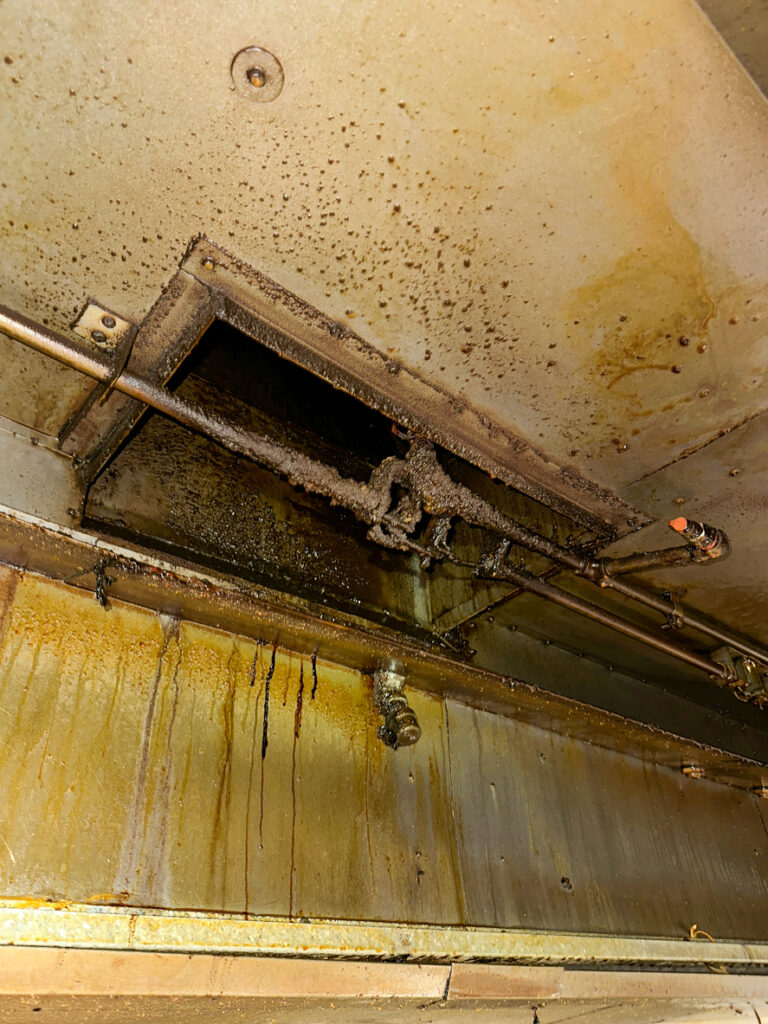
Most hood cleaning quotes cover the part of the system you can see from the kitchen floor. The grease that starts fires is further up, in the plenum behind the filters, along the horizontal duct runs above the ceiling, and inside the fan housing on the roof. We clean the full path to bare metal wherever the system allows it, photograph every section, and tell you plainly where access is missing. If a duct run cannot be reached without an access panel, you will know, and we can fit one so it gets cleaned properly from then on.

Every kitchen accumulates grease. What changes by facility type is when you can be shut down and who audits your records — and Northeast Ohio runs the full range, from hospital kitchens that never close to school districts that only open up in summer and arena concessions that swing with the event calendar.
One room in Cleveland or a dozen across the region — the compliance file is yours to keep current and the fire risk is yours to carry.

A kitchen serving one lunch period reads as low-volume on paper and often is not, because the line runs hard for two hours and then sits.

Northeast Ohio’s arena, ballpark and stadium kitchens swing from dark to full output on an event schedule, so we build the cleaning calendar around the event calendar.

In a region anchored by major health systems, these kitchens never close and the people they feed cannot be moved, so the work happens in phased windows that keep production running.

From city districts to the region’s university campuses, the real shutdown window is summer and there is almost none during term. We use it for bare-metal cleaning, access panels and fan service.

Breakfast service, banquet kitchens and a restaurant that may run late often share ductwork and a roof. We map what is actually connected to what before quoting, so you are not paying to clean one system twice while a shared duct run goes untouched.
What facility managers, owners and operators in Northeast Ohio ask us most often about exhaust cleaning, documentation and who is responsible for what.
The code sets the inspection interval by how hard the kitchen runs. Solid fuel cooking is inspected monthly, high-volume operations running twelve to twenty-four hours a day quarterly, moderate-volume kitchens running six to twelve hours semiannually, and low-volume operations under six hours annually. Cleaning is required whenever that inspection finds grease accumulation, which for most working kitchens makes the inspection interval the cleaning interval in practice. Your local fire authority can require more frequent service, and some jurisdictions in Northeast Ohio do.
The full grease path, cleaned to bare metal wherever the system allows: hood and filters, the plenum behind them, the horizontal duct runs above the ceiling, the vertical riser, and the fan housing on the roof. A quote that covers only what’s visible from the kitchen floor leaves out the sections where fires start and spread. Where access panels don’t exist and a duct run genuinely can’t be reached, the code requires that area to be documented as not cleaned rather than quietly skipped.
A certificate showing the date of inspection or cleaning, kept on the premises, and a label in the kitchen listing the date, the servicing company, and any areas that could not be cleaned. Photo documentation isn’t required by the code, but it’s what settles a disagreement with an inspector or an adjuster, which is why we photograph every section of the system on every visit and send the report the same day.
The lease decides it, and it’s worth reading before an inspection rather than after one. Building owners commonly retain the ductwork and rooftop fan as building infrastructure while the tenant handles the hood and filters, which leaves the middle of the system as the part nobody scheduled. When we survey a property we map the full run and tell you where the split falls, so the gap shows up on a report instead of in a fire marshal’s notice.
Most commercial property policies condition kitchen fire coverage on documented compliance with NFPA 96, and a carrier reviewing a claim will ask for the service records first. A grease fire in an uncleaned duct with no certificate on file is the scenario where coverage gets contested.
No. We work around your service hours, which usually means overnight or early morning for restaurants, between events at venues, and during scheduled closures for schools and corporate cafeterias. We give you the window before the job is booked, so it lands on your calendar rather than in the middle of a shift.
Hood cleaning as much of the industry sells it stops at the hood and the filters. Full system cleaning follows the grease the whole way through the plenum, duct, riser and rooftop fan, and it’s the only version that satisfies NFPA 96 or removes the fuel from the part of the system a fire would travel through.
Frequently both. Restricted airflow shows up first as a hot kitchen and a dining room that smells like the fryer, and the cause is usually loaded filters or a grease-choked duct, though a worn belt or a failing upblast fan produces the same symptoms. We diagnose it during cleaning while the system is already open, which is when a repair costs the least and interrupts the least.
Kitchen Guard of Northeast Ohio works out of 3592 S. Arlington Rd in Akron and services commercial kitchens across Cleveland, Akron, Canton, Youngstown and the surrounding communities.


