
Fan Belt Failure Is the Most Predictable Emergency in Your Kitchen
San Diego kitchens do not get an off-season. Patios are full in February, tourism peaks through the summer, and the hood over your line pulls heat and grease-laden vapor every single service. The component most likely to shut all of that down is a rubber belt that costs less than a case of produce.
The one part in your exhaust fan that is designed to wear out
The drive belt connects your fan motor to the fan wheel. Every bit of air your hood moves depends on that connection holding tension. When the belt starts to slip, the wheel turns slower than the motor is asking it to, and your capture velocity drops long before anyone hears a noise or sees a problem.
This is what makes belts different from the rest of your exhaust system. A motor or a bearing is something you diagnose. A belt is a consumable, like a filter or a fryer gasket. It is supposed to be replaced on a schedule, not investigated after it fails at 7:30 on a Saturday.
What San Diego weather actually does to a drive belt
Operators from other markets assume mild weather is easy on rooftop equipment. It is not. It is just quieter about it.
Within a few miles of the water, from Pacific Beach and Point Loma out to Coronado and Imperial Beach, salt air pits and corrodes sheaves, hardware, and fan housings. A corroded pulley groove is abrasive, and it will chew through a brand new belt in a fraction of its normal life. Farther inland, in Escondido, El Cajon, and Santee, sustained rooftop heat through the summer hardens and glazes rubber, so belts lose their grip before they ever look worn out. The May and June marine layer leaves rooftop equipment damp overnight, and Santa Ana winds drive grit into the sheave grooves. The result is a slow, constant grind rather than one dramatic seasonal event.
That is exactly why it gets missed. There is no freeze to blame and no obvious moment when the damage happened.
The warning signs a belt gives you before it snaps
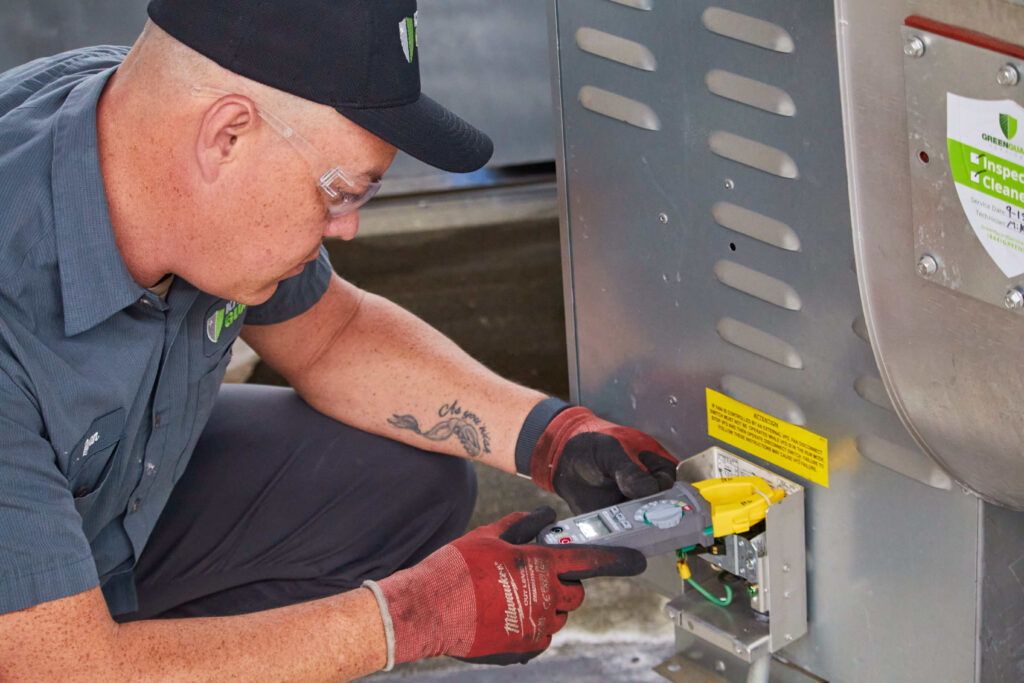
A belt almost always tells you it is failing. On a service call we listen for a squeal or chirp at fan startup. It fades once the wheel is up to speed. Fine black dust on the fan housing or roof curb is the belt shedding itself. We check the sidewalls for glazing and the V-groove for cracking. Deflection at the midpoint of the span tells us whether tension is holding. Then we compare motor amp draw against nameplate full-load amps. A reading under spec means the wheel is not carrying the load it was designed to carry.
Inside the building, the symptoms are simpler. Smoke hangs under the hood instead of clearing. The line runs hotter than it should. Odors drift into the dining room or out onto the patio. If your staff is noticing any of that, the belt has usually been slipping for weeks.
How the quarterly Fan Maintenance Program handles it
Kitchen Guard of San Diego runs fan maintenance as a quarterly service plan rather than a once-a-year visit. On each visit our certified technicians lubricate the Zerk fittings, clean the motor casing, and test amp draw. They also check belt tension and sheave alignment. A misaligned or corroded pulley will destroy a new belt no matter how well it is installed. Belts are replaced on a bi-annual cycle, or sooner when run hours or a coastal location call for it.
The part most operators care about: after 30 days in the program, motors, belts, and bearings are covered by a lifetime warranty. That changes the calculation on a wear item from an unpredictable repair bill into a fixed line on your budget.
What it costs to find out the hard way
When an exhaust fan stops, the kitchen stops with it. Heat builds on the line, and smoke stops clearing and starts moving into the dining room. That leaves you cooking in conditions your staff should not be working in. The alternative is turning away covers on a night you cannot afford to lose. Your hood is also your first line of defense against a grease fire, and a fan that is not turning is a defense that is not working.
Our technicians carry common repair parts on their service vehicles, so most belt and bearing problems are diagnosed and fixed in a single visit, and we answer emergency calls 24 hours a day across San Diego County. That is the right safety net to have. It is still more expensive and more disruptive than the scheduled visit that would have prevented it.
The compliance side operators tend to forget
Belt condition is not just a performance question. Reduced airflow and the grease conditions that come with a neglected fan both feed into NFPA 96 findings, and a rooftop unit that has been left alone rarely fails inspection for one clean reason. We document repair and maintenance work with photographs, so when a health inspector or the fire marshal asks what has been done to your system and when, you have an answer with dates attached rather than a memory.
When the belt is not really the problem
Sometimes a belt that keeps failing is a symptom. Grease loading on the fan wheel throws the assembly out of balance and shreds belts prematurely. Worn or corroded sheaves will not hold a belt no matter how new it is. Failing bearings add drag the belt has to fight. And a motor near the end of its life will keep eating belts until it is replaced.
At some point the honest answer is that repeat repairs cost more than a new fan. We handle upblast and utility-set fan replacements as well, and we will tell you when you have crossed that line instead of selling you another belt.
Frequently asked questions
Do coastal kitchens really need belts changed more often?
In our experience, yes. Salt-air corrosion on the sheave is the difference, not the belt itself. A pitted pulley groove acts like a file, so a coastal rooftop can go through belts noticeably faster than an inland one running the same hours.
What does the lifetime warranty actually cover?
After 30 days in the Fan Maintenance Program, motors, belts, and bearings are covered for the life of your enrollment. Ask us to walk you through the specifics for your equipment before you sign up so there are no surprises.
Can you service the fan without shutting down my kitchen?
In most cases yes. Belt replacement and routine fan maintenance happen on the roof and take a short window, so we schedule around your service hours rather than through them.
My fan is down right now. How fast can you get here?
Call 760-743-4733. We run 24/7 emergency service across San Diego County, including Escondido, Chula Vista, and El Cajon, and our trucks carry the common parts needed to finish most repairs on the first visit.
Can my handyman just put a new belt on?
A belt can be changed by anyone. Whether it lasts depends on correct sizing, tension, and sheave alignment, and rooftop work carries real fall and electrical risk. Work that is not documented also does nothing for you at your next inspection.
Get ahead of the belt instead of reacting to it
Kitchen Guard of San Diego provides commercial kitchen exhaust repair and maintenance for restaurants, hotels, hospitals, and food service operations throughout San Diego County. Our certified Repair Technicians work to NFPA 96 standards, use only UL-listed components, and document every repair photographically. Call 760-743-4733 to ask about the quarterly Fan Maintenance Program.


