NFPA 96 Compliance in San Diego: What Every Restaurant Owner Must Know in 2026

San Diego is one of the most dynamic food cities in the United States. With more than 8,100 restaurants and over 13,800 permanent retail food facilities spread across 18 cities and unincorporated communities throughout the county, the competition is fierce — and so is the regulatory oversight. According to the San Diego County Department of Environmental Health and Quality (DEHQ), Environmental Health Specialists conduct more than 32,000 food facility inspections every year, serving the 2.9 million residents and the more than 14.7 million overnight visitors who come through San Diego annually.
In that environment, a failed inspection doesn’t just sting — it can cost you your grade card, your permit, and your reputation. At the center of fire safety compliance for every one of those kitchens is a single standard: NFPA 96.
What Is NFPA 96 — and Why Does It Govern Your San Diego Kitchen?
NFPA 96, formally titled the Standard for Ventilation Control and Fire Protection of Commercial Cooking Operations, is published by the National Fire Protection Association. The standard, continuously developed since 1969, provides preventive and operative fire safety requirements intended to reduce the potential fire hazard of both public and private commercial cooking operations. The current edition is the 2024 edition, with the 2027 edition already in development and issuance approved as of May 2026.
NFPA 96 is not a suggestion. It is adopted into the California Fire Code (CFC), which the City of San Diego enforces through the San Diego Municipal Code, Chapter 5, Article 11. The City formally adopted the 2025 California Fire Code, which became effective January 1, 2026, through local amendments approved by City Council (Ordinance O-22043). Every commercial kitchen in the City of San Diego — and throughout the county — is legally required to meet NFPA 96 standards right now.
The San Diego Fire-Rescue Department’s Community Risk Reduction Division oversees enforcement. Their Deputy Fire Marshals conduct fire inspections across the city’s north, south, and metro regions, and are trained to identify kitchen exhaust system violations. The inspection line is 619-533-4388.
The Scale of the Risk in San Diego
San Diego’s geography and climate make fire risk uniquely serious. The region is one of the driest urban environments in the country, and the San Diego Fire-Rescue Department lists wildfire and structure fire prevention as core priorities year-round. Commercial kitchen grease fires are among the leading causes of restaurant structure fires nationally, and grease-laden exhaust systems are the primary ignition pathway.
For San Diego operators, the stakes are compounded by the sheer volume of the food scene. From high-volume kitchens at venues like Petco Park and Snapdragon Stadium to the packed restaurant corridors of the Gaslamp Quarter, Little Italy, and Pacific Beach, kitchens here run hard and hot. Grease accumulates faster than operators often realize — and NFPA 96 exists precisely to manage that hazard before it becomes a catastrophe.
NFPA 96 Cleaning Frequency Requirements: What San Diego Kitchens Must Follow
One of the most commonly misunderstood parts of NFPA 96 is the cleaning schedule. The standard does not apply a one-size-fits-all approach. Cleaning intervals are based on the type and volume of cooking at your facility.
Monthly cleaning is required for systems serving solid fuel cooking operations (wood-burning ovens, charcoal grills) and high-volume operations such as 24-hour restaurants and quick-service chains. Many of San Diego’s busiest Gaslamp Quarter restaurants and Mission Valley fast-casual operators fall into this category.
Quarterly cleaning applies to moderate-volume operations — the typical full-service restaurant, hotel kitchen, or hospital cafeteria. This includes most of San Diego’s dining establishments from Carlsbad to Chula Vista.
Semi-annual cleaning covers seasonal businesses or operations with lower cooking volume, such as some educational institution cafeterias and catering commissaries.
Annual cleaning is the minimum for very low-volume operations such as day camps, churches, or community centers with infrequent cooking.
When a San Diego Fire Marshal or DEHQ inspector asks for your hood cleaning records, these are the intervals they are checking against. If your documentation doesn’t match the appropriate frequency for your kitchen type, you are out of compliance — regardless of how clean the hood looks on the day of inspection.
How San Diego County Enforces Compliance at the Local Level
Kitchen fire safety compliance in San Diego County involves two overlapping enforcement bodies.
The San Diego County Department of Environmental Health and Quality (DEHQ) administers the Food Program under the California Retail Food Code (CalCode). Their Environmental Health Specialists conduct risk-based inspections at all 13,800+ retail food facilities in the county. DEHQ uses a graded letter system — an A (90–100), B (80–89), or C (79 and below) — and that grade card must be posted near your public entrance at all times. When an imminent health or safety hazard is identified, DEHQ has the authority to close a facility on the spot and require written authorization before you can reopen.
The San Diego Fire-Rescue Department enforces fire code compliance including NFPA 96 requirements through its Community Risk Reduction Division. Deputy Fire Marshals conduct inspections citywide and maintain specific programs for licensed facilities and night detail inspections — meaning your kitchen can be reviewed outside of normal business hours. Fire code violations can result in Notice of Violation (NOV) issuance, mandatory re-inspection fees, and in serious cases, operational restrictions or closure orders.
These two agencies work independently but are both looking at your kitchen. A kitchen that passes a health inspection can still fail a fire inspection for an unclean exhaust system — and vice versa.
What a Fully NFPA 96-Compliant Hood Cleaning Covers
Not every hood cleaning service delivers NFPA 96 compliance. A compliant service covers the entire exhaust pathway — from the filters at the hood canopy all the way to the rooftop exhaust fan:
Hood Canopy: All interior and exterior surfaces degreased, including welds, seams, and ledges where grease pools.
Grease Filters: Removed and either cleaned to full capacity or exchanged. Clogged filters are a primary NFPA 96 violation and one of the fastest ways to fail a fire inspection.
Ductwork: The entire duct run must be cleaned, with proper access panels installed at intervals that allow complete cleaning. If your ducts don’t have adequate access points, your system cannot be fully cleaned — and an inspector will know it.
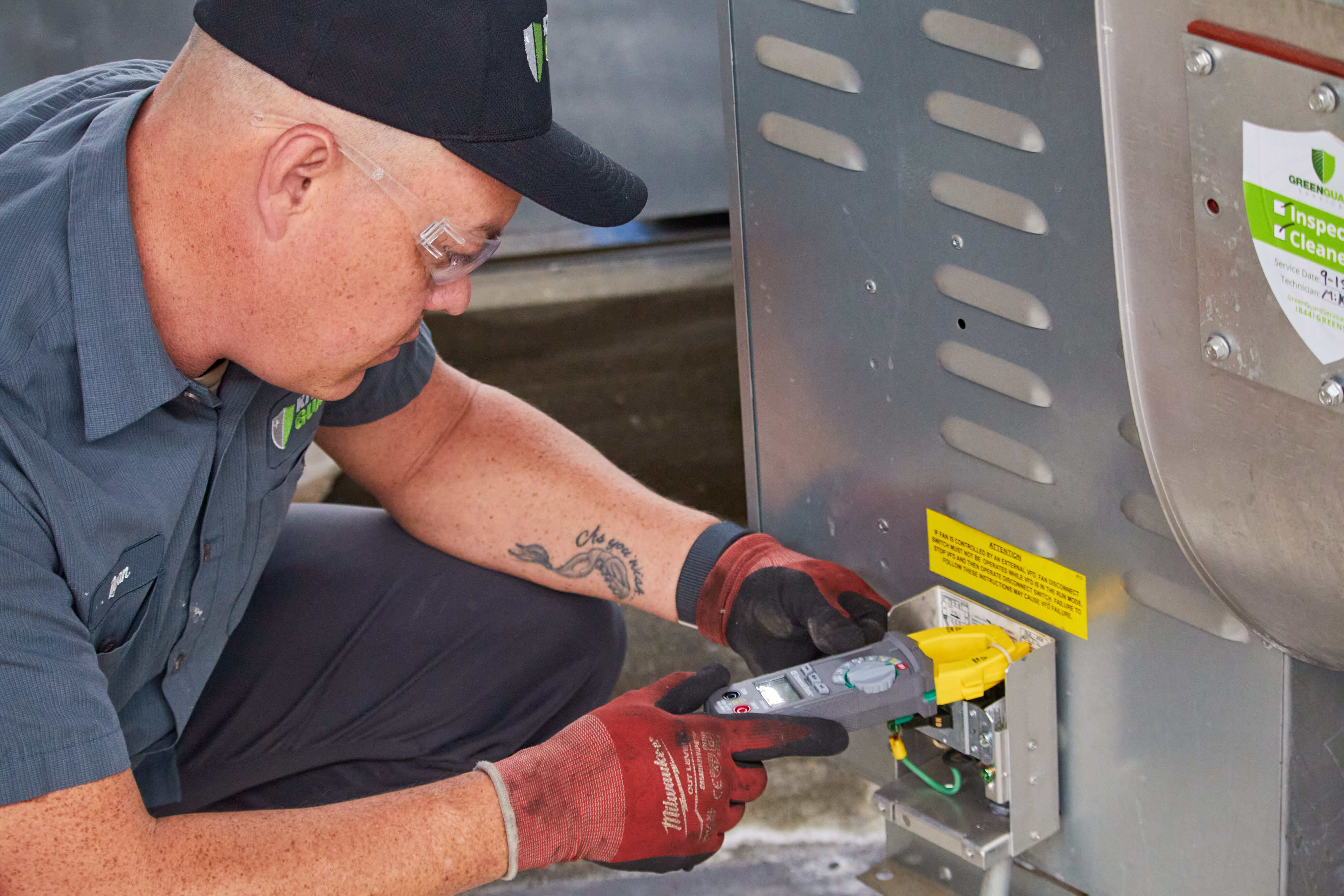
Rooftop Exhaust Fan and Housing: The fan motor, housing, and surrounding roof area must be cleaned and inspected. Grease accumulation on rooftop fans is a leading cause of exterior structure fires and a common point of failure during San Diego fire inspections.
Service Documentation: After every compliant cleaning, a compliance sticker must be placed on the hood listing the company name, service date, and next scheduled service date, along with a written service report — the documents a San Diego fire inspector or DEHQ specialist will request on-site.
The Real Consequences of Non-Compliance in San Diego
Insurance denial. If a grease fire occurs in a kitchen with documented cleaning failures, your insurer can deny the claim. A single kitchen fire can cause hundreds of thousands of dollars in damage. In a dense corridor like Little Italy or the Gaslamp, that risk extends to neighboring properties.
Inspection failure and re-inspection costs. The San Diego Fire-Rescue Department charges fees for re-inspections following a Notice of Violation. Repeated violations escalate to administrative hearings and can result in suspension or revocation of your health permit.
Forced closure. DEHQ has the authority to close your facility immediately when an imminent hazard is identified — which means lost revenue, staff sent home, and permanent reputational damage on public inspection record sites like EatSafeSanDiego.org.
Your public grade. In San Diego County, your inspection grade is public, posted at your door, and viewable online. A “B” or “C” on your window is visible to every customer who walks by — and in a city this competitive, it matters.
Who Kitchen Guard Serves Across San Diego County
Since 2009, Kitchen Guard has provided NFPA 96-compliant hood cleaning and kitchen exhaust services across San Diego County: restaurants from Mission Valley to La Jolla (including Carl’s Jr. and Five Guys), hotels and resorts from the Gaslamp to Coronado, sports venues including Petco Park and Snapdragon Stadium, healthcare facilities including Sharp and Scripps-affiliated kitchens, educational institutions from UCSD and SDSU to K-12 cafeterias, and corporate cafeterias in Sorrento Valley and downtown.
We serve all of San Diego, Pacific Beach, La Jolla, Mission Valley, Chula Vista, Carlsbad, Oceanside, Escondido, El Cajon, Encinitas, Coronado, Del Mar, Rancho Bernardo, Poway, National City, La Mesa, Santee, Temecula, and communities throughout San Diego County.
Get Your Complimentary Hood Inspection Today
The San Diego County DEHQ conducts over 32,000 inspections a year. The San Diego Fire-Rescue Department has Deputy Fire Marshals operating across every region of the city. NFPA 96 is enforceable law in San Diego as of January 1, 2026 under the 2025 California Fire Code. The question is not whether your kitchen will be inspected — it’s whether you’ll be ready.
Kitchen Guard of San Diego offers a complimentary hood inspection to help you understand exactly where your exhaust system stands. Our certified technicians will assess your hood, ductwork, filters, and rooftop fan, identify any compliance gaps, and set you up with a maintenance schedule tailored to your specific operation.
📞 Call us: 760-743-4733
🌐 Schedule online: kitchenguard.com/san-diego/contact
Don’t wait for a failed inspection, a grease fire, or a CLOSED sign on your door. Kitchen Guard keeps San Diego kitchens safe, compliant, and open.