What a Commercial Hood Cleaning Includes: A Houston Owner’s Guide to Full-System Service
If you run a commercial kitchen anywhere in the Houston metro, “hood cleaning” is an item that is easy to buy and hard to verify. Two vendors can quote the same kitchen, use the same words, and deliver very different work. One cleans the entire grease path and hands you a documented service record. The other wipes the parts a customer can see and calls it done. The difference does not show up on the invoice. It shows up during an inspection, or worse, during a fire. This guide breaks down what a proper commercial hood cleaning actually includes, what happens step by step during a professional visit, how often a Houston kitchen needs the full service, and how to tell a complete cleaning from a surface clean before you sign. The goal is to help you buy the right work the first time and stay inspection-ready year round.
What “Hood Cleaning” Actually Means for a Commercial Kitchen
The phrase is misleading. The hood is only the visible front end of a connected system, and cleaning it in isolation does almost nothing for your fire risk. A commercial kitchen exhaust system is a continuous path: grease-laden vapor rises off the cooking line, enters the hood canopy, passes through the baffle filters, travels up the ductwork, and exits through the exhaust fan on the roof. Grease condenses and hardens along that entire path, not just where you can reach it.
So when the work is done correctly, professional commercial kitchen hood cleaning in Houston means cleaning the whole system, bare metal to bare metal wherever the standard requires it. That is the definition worth holding a provider to. Anything narrower is a partial cleaning wearing the same name.
Why the Whole System Matters More in Houston
Houston kitchens work hard, and the climate does not help. Long operating hours, high-output equipment, and the region’s heat and humidity all push grease through the exhaust system faster than in cooler, drier markets. A cadence that keeps a system clean elsewhere can run short here, and the buildup accumulates where no one is looking, inside the ductwork and around the fan.
There is also a simple safety reason the whole path matters. Cooking equipment is the leading cause of structure fires in eating and drinking establishments, and grease is the fuel. According to NFPA fire research, cooking is the top contributor to these fires. When a flare-up on the line reaches a hardened layer of grease inside the duct, it stops being a pan fire and becomes a system fire that travels.
The standard behind proper cleaning reflects this. NFPA 96, the Standard for Ventilation Control and Fire Protection of Commercial Cooking Operations, sets the baseline for how these systems are designed, operated, inspected, and maintained, and its core expectation is that the entire grease-carrying path stays clean enough that a flare-up cannot find fuel. That is why a compliant cleaning is measured by scope, not appearance. A kitchen can look spotless at the cook line while the most dangerous grease sits hardened inside a horizontal duct run, which is exactly why “we cleaned the hood” is not the same as “we cleaned the system.”
Who Enforces Hood Cleaning Across the Houston Metro
Enforcement in the Houston area depends on your address. Kitchens in unincorporated Harris County fall under the Harris County Fire Marshal’s Office, whose inspectors evaluate commercial kitchens against the adopted fire code and give cooking operations extra scrutiny because of their fire load. Kitchens inside city limits answer to their municipal fire marshal. Above the local level, the Texas State Fire Marshal’s Office, part of the Texas Department of Insurance, oversees fire safety programs statewide.
For an operator, the takeaway is consistent across jurisdictions: hood cleaning is a compliance expectation backed by local and state authorities, and it is verified during inspection. That reality holds whether your kitchen is in the city core, a suburban strip center, or a standalone building out past the loop.
The Heart of the Job: Cleaning the Entire Grease Path
The core of a commercial hood cleaning is the systematic removal of grease from every component the vapor touches. A credible provider can name each part of that path and tell you exactly how they clean it. The six components below are what “full-system” actually refers to, and each one is a place where a partial cleaning tends to fall short.
1. The Hood Canopy and Capture Area
This is the visible workhorse. The canopy and its interior surfaces are where grease first collects as vapor is pulled off the line. A proper cleaning degreases the interior of the canopy, the capture edges, and the surfaces around the lighting and controls, not just the stainless exterior a customer sees. Clean capture surfaces keep the system pulling efficiently and reduce the grease that migrates deeper.
2. The Baffle Filters
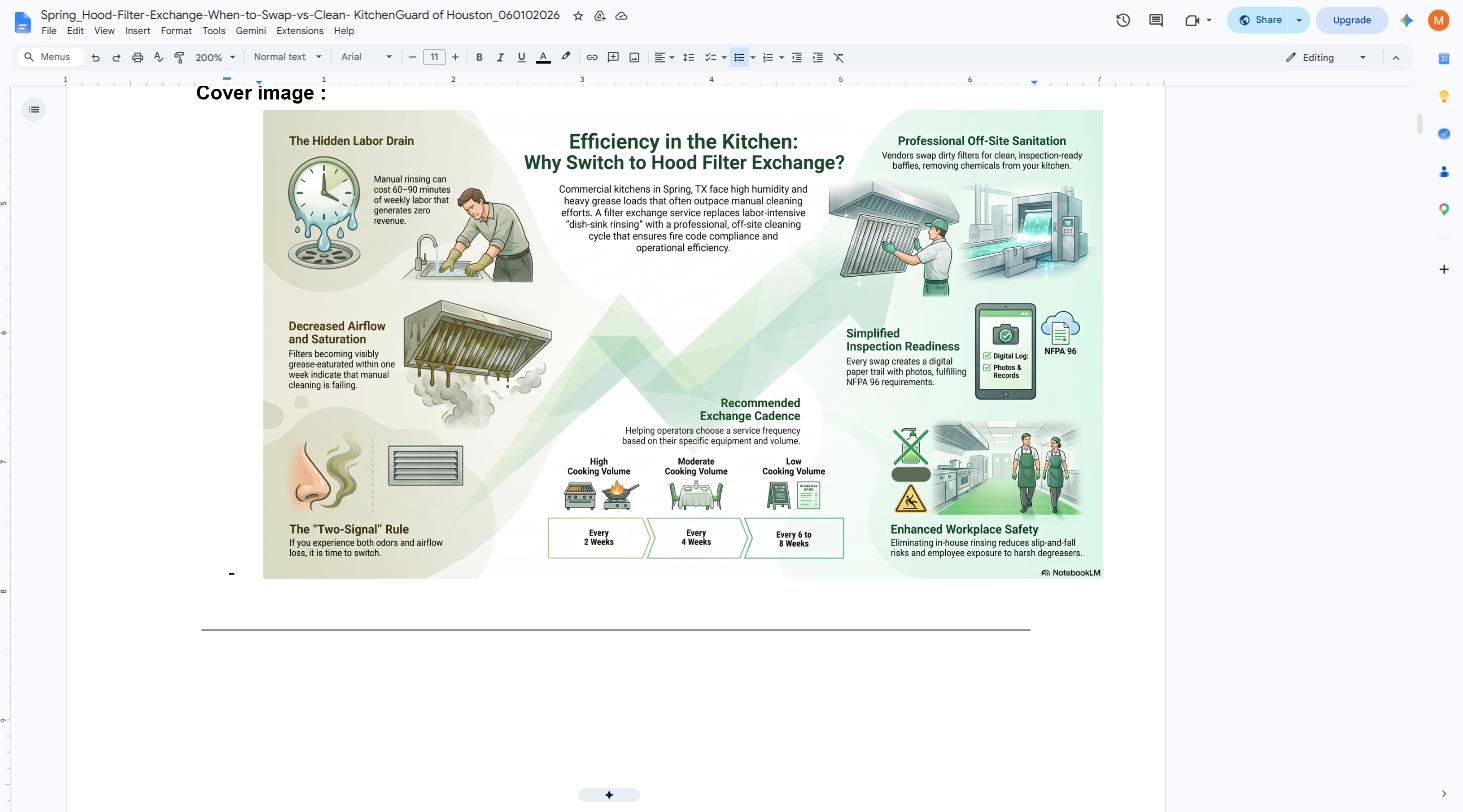
Baffle filters are the first line of grease capture, and they load up fast in a busy Houston kitchen. A full-system cleaning removes the filters, degreases or exchanges them, and confirms they seat correctly on reinstall. Many operators pair cleanings with a recurring hood filter exchange so a clean, inspection-ready set is always in the hood and staff are not rinsing greasy filters at the dish sink between services.
3. The Horizontal and Vertical Ductwork
The ductwork is where the real fire risk hides. Grease pools in horizontal runs and coats the vertical rises out of sight, and it is the exact area a surface clean never touches. A compliant cleaning opens the duct through access points and cleans the interior duct walls along the full run, because hardened grease in the ducts is the fuel that turns a small flare-up into a traveling fire.
4. The Exhaust Fan and Housing
The exhaust fan pulls the whole system, and a grease-laden fan is both a fire hazard and an airflow problem. A full cleaning services the fan blades, the housing, and the surrounding components so the system keeps moving air the way it was designed to. A fan that is starved by grease or a clogged system also works its motor harder, which is how a maintenance shortcut turns into a mechanical repair later.
5. Rooftop Components and Grease Containment
On most Houston kitchens, the fan sits on the roof, and grease that is not contained ends up on the roofing membrane. A thorough provider services the rooftop components and confirms grease containment is in place and functioning. When containment has failed or the fan needs mechanical attention, that is where exhaust fan repairs and rooftop grease containment become part of keeping the full system compliant rather than an afterthought.
6. Access Panels, Opened and Resealed
NFPA 96 expects the system to be accessible for cleaning and inspection. That means access panels get opened, the duct is cleaned through them, and the panels are properly resealed afterward. Missing, undersized, or improperly sealed access panels are one of the most common inspection findings, and they usually signal that stretches of duct have never been cleaned at all.
What Actually Happens During a Professional Visit
Knowing the components is half the picture. The other half is the process, because how a crew works determines whether your kitchen is protected, whether the job is complete, and whether you can prove it later. A well-run visit follows a predictable sequence from arrival to sign-off.
1. Pre-Service Walkthrough and Kitchen Protection
The visit starts before any cleaning. A trained crew walks the system, notes the layout and condition, and protects the space, covering cooking equipment and surrounding surfaces so degreasing chemicals and runoff do not end up where they should not. This step is also where a good provider flags anything unusual, like damaged filters or access issues, before the work begins.
2. Disassembly, Containment, and Degreasing
The crew removes the filters, opens the access panels, and sets up containment to catch runoff. Then the actual cleaning happens: the canopy, filters, duct interior, and fans are cleaned to NFPA 96 standards, using the right combination of scraping and chemical treatment for the level of buildup. This is the labor-intensive core of the service, and it is the part a surface clean skips.
3. Exhaust Fan and Rooftop Service
With the interior path handled, the crew services the exhaust fan and the rooftop components, degreasing the fan and housing and confirming grease containment. Rooftop work is where corner-cutting providers tend to disappear, so it is worth confirming up front that the roof is part of the scope and not an optional add-on.
4. Reassembly, Cleanup, and Final Walkthrough
Panels are resealed, filters are reinstalled and seated correctly, and the kitchen is cleaned up so it is ready for the next service. A final walkthrough confirms the system is reassembled properly and that nothing was left loose or unsealed. A kitchen should come back online in better shape than the crew found it, with no mess left behind.
5. Documentation and Next-Service Scheduling
The visit ends with a service record: what was cleaned, when, by whom, and the condition of the system, with before-and-after photos. This is the document you hand to an inspector or an insurer, and it is the part that protects you. A good provider also recommends the date for the next cleaning based on how your kitchen actually loads the system.
How Often a Houston Kitchen Needs the Full Service
NFPA 96 does not put every kitchen on the same schedule. It ties cleaning frequency to how much and what kind of cooking you do, because the heavier the grease load, the faster the system needs professional service. The cadence below reflects the standard NFPA-aligned frequency.
| Kitchen Type | Typical Examples | Recommended Cleaning Frequency |
|---|---|---|
| High-volume | 24-hour operations, wok cooking, charbroiling, solid-fuel | Monthly |
| Moderate-volume | Sit-down restaurants, standard commercial kitchens | Quarterly |
| Low-volume | Churches, day camps, seasonal operations | Semi-annually |
If you are not sure where your kitchen falls, that is a normal question and worth getting right. Check the NFPA 96 guidelines or consult your local fire marshal, and build the schedule around your actual cooking profile rather than a guess. Hours, fuel type, and menu all shift the interval, so a high-output kitchen in the summer rush may need tighter timing than the same room in a slower season.
Full-System vs. Partial Cleaning: What a Surface Clean Leaves Behind
A partial cleaning leaves the exact areas inspectors and insurers care about most. The comparison below shows where the two diverge.
| System Component | Full-System Cleaning | Typical Surface Clean |
|---|---|---|
| Hood canopy interior | Degreased fully | Wiped where visible |
| Baffle filters | Cleaned or exchanged, reseated | Rinsed or skipped |
| Duct interior | Cleaned through access panels | Not touched |
| Exhaust fan and housing | Serviced | Often skipped |
| Rooftop components | Serviced, containment checked | Rarely addressed |
| Documentation | Photos and written record | None |
The tell is simple. If a provider cannot describe how they clean the ductwork and the fan, or cannot show you what the finished documentation looks like, you are likely buying a surface clean at a full-system price.
The Service Record You Should Receive
Under NFPA 96, documentation is part of compliance, not courtesy. After each cleaning you should receive a record that stands on its own during an inspection or an insurance question. A strong service record typically includes:
- The date of service and the specific areas of the system cleaned
- Before-and-after photos of the hood, ductwork, and exhaust fan
- Notes on access panel work and any conditions found
- The name of the company and the technician who performed the work
- The recommended date for the next scheduled cleaning
A kitchen that can produce a clear service history demonstrates a maintained system at a glance, which is exactly what an authority having jurisdiction wants to see. Keeping that paperwork organized is one of the simplest ways to make inspections uneventful.
Questions to Ask a Houston Hood Cleaning Provider
You do not need to be an exhaust expert to vet a provider. You need a few direct questions that separate full-system operators from surface cleaners. Ask these before you sign:
- Will you clean the ductwork interior, the fan, and the rooftop components, or just the hood and filters?
- How do you access the duct, and will you open and reseal access panels?
- What does your finished documentation include, and can I see a sample?
- How do you protect my equipment and contain runoff during the work?
- How will you recommend my cleaning frequency, and what is it based on?
A credible provider answers each of these in concrete terms. Vague answers, or a quick pivot to price, tell you what you need to know.
Red Flags That Signal a Provider Cuts Corners
Certain patterns show up again and again with providers who deliver less than they charge for. Watch for these:
- A scope description that never mentions the ductwork or the fan
- “We don’t do the roof” or “the fan is too hard to access”
- “We’ll take a few photos” with no real report packet behind it
- No plan for opening and resealing access panels
- Pricing that undercuts everyone but comes with no written scope
Any one of these is worth a second look. Two or more, and you are almost certainly looking at a partial cleaning. Price alone is a poor filter, because the cheapest quote is often the one that skips the ductwork and the roof, which is where the risk and the cost actually live.
Where Filter Exchange, Pressure Washing, and Repairs Fit In
A full-system cleaning handles the exhaust path on a cadence, but it is not the only service that keeps a kitchen compliant and clean. Filter handling between cleanings is where a recurring baffle filter exchange keeps airflow strong and takes the greasy-filter chore off your staff. Exterior grease and rooftop buildup are where commercial pressure washing pairs naturally with the same visit. And when the crew flags a worn belt, a failing hinge, or a grease-loaded fan, exhaust fan and rooftop repairs address the mechanical issues before they become downtime.
The cleanest operators run these under one vendor relationship, so the documentation lines up and inspection conversations stay simple instead of spread across multiple companies.
Inspection Readiness for Houston Commercial Kitchens
Inspection readiness is not a scramble the week the fire marshal is due. It is the natural result of cleaning the full system on schedule and keeping the paperwork current. A kitchen on a disciplined cadence walks into an inspection with clean equipment and a service history that answers the questions before they are asked.
Getting ahead of the cycle is also cheaper than reacting to it. A failed inspection can mean re-inspection fees and pressure to correct on a deadline, and a missing service record can complicate an insurance claim at the worst possible moment. Keeping the system clean and documented turns those risks into non-events, no matter where in the metro your kitchen sits.
What Falling Behind Actually Costs
Stretching or skipping cleanings does not save money. It moves the cost somewhere more expensive and less predictable. The risks fall into a few clear categories.
| Area of Risk | What Falling Behind Can Mean |
|---|---|
| Fire safety | Grease build-up in the ducts becomes fuel for a fast-spreading system fire |
| Inspection | Failed inspection, re-inspection fees, and correction on a deadline |
| Insurance | Claims complicated or denied when maintenance records are missing |
| Equipment | A grease-choked system overworks the fan motor, inviting a costly repair |
| Downtime | Emergency service during peak hours instead of a planned visit |
None of these are hypothetical. They are the ordinary consequences of treating a safety system like an optional expense, and they cost more than the cleanings that would have prevented them.
Serving Commercial Kitchens Across the Houston Metro
Grease does not care what suburb you are in, and neither does the standard. The same full-system approach applies whether a kitchen is downtown or in the surrounding communities. Kitchen Guard of Houston serves operators across the metro, including Katy, Spring, Cypress, Sugar Land, Memorial, the Galleria area, and The Woodlands.
The advantage of a metro-wide provider is consistency: one scope, one documentation standard, and one point of contact, which matters most for multi-unit operators keeping several kitchens on the same compliant cadence.
Next Step: Book a Complimentary Scope Review
Kitchen Guard of Houston builds every engagement around the full grease path, clear scope, and documentation that supports your compliance file. A typical relationship starts with a site walk to understand your system, your cooking volume, and your current condition. From there the scope is set, the cadence is matched to how your kitchen actually loads the system, and each visit closes with a service record you can hand an inspector. Damaged filters, access issues, or fan problems get flagged with a plan and a cost, so you decide with full information rather than reacting to a bill.
If you are not certain what your current provider is actually cleaning, the fastest way to find out is a walkthrough of your system and a clear, written scope. You can request a complimentary scope review for your Houston kitchen and we will walk the system, explain what a full-system cleaning covers for your specific setup, and set a cadence that keeps you compliant without overpaying.
To get started, call Kitchen Guard of Houston at 713-489-0790 or visit us at 5479 W Sam Houston Pkwy N, Houston, TX 77041. Whether you run one kitchen or several across the metro, the goal is the same: a clean system, a clear record, and inspections that come and go without drama.
Frequently Asked Questions
How long does a commercial hood cleaning take in Houston?
It depends on the size of the system, how heavily it is loaded, and rooftop access, but most single-hood kitchens are serviced outside operating hours so the work does not interrupt service. A larger or heavily loaded system takes longer, which is one reason a good provider walks the system before quoting a time.
How much does hood cleaning cost in Houston?
Cost is driven by the size and configuration of your system, how much grease has built up, the number of hoods and fans, and rooftop access, so a credible quote follows a look at your actual setup rather than a flat phone estimate. The more useful question is whether the price covers the full system, because a low quote that skips the ductwork and fan is not cheaper, it is incomplete.
What is the difference between hood cleaning and filter exchange?
A full hood cleaning services the entire exhaust path on a cadence. A filter exchange is a focused, recurring swap of the baffle filters that keeps airflow strong between cleanings. Most kitchens benefit from running both, since they solve different parts of the same problem.
Do you clean the rooftop exhaust fan too?
Yes. The exhaust fan and rooftop components are part of the full system and part of a compliant cleaning. Any provider who treats the roof as optional is describing a partial cleaning.
How do I know my kitchen is inspection-ready?
You are inspection-ready when the full system has been cleaned on the right cadence for your cooking volume and you can produce a current service record with before-and-after photos. If you cannot put your hands on that documentation, that is the first gap to close.